
If you are eligible, a VA home loan is one of the most powerful money tools the military benefit system offers. It is not “free housing” and it is not a shortcut around good financial habits. But it can remove two of the biggest barriers to buying a home: a giant down payment and expensive monthly mortgage insurance.
Below are the biggest VA home loan benefits in plain English, who tends to get the most value from them, and the tradeoffs you should price in before you apply.

Benefit #1: You may be able to buy with zero down
The headline perk is real: many buyers can purchase a primary residence with 0% down using a VA loan. That can mean keeping thousands of dollars available for moving costs, repairs, furnishing the home, and having a real emergency fund after closing.
Important nuance: zero down is most straightforward when you have full VA entitlement available (think of entitlement as the amount of VA guarantee you have available to use). If you have partial entitlement because you have an existing VA loan or you used some entitlement in the past that is not restored yet, a down payment may be required, especially on higher-priced homes.
When zero down usually works
- You are buying a primary home (not a vacation home or investment property).
- The purchase price is at or below the home’s appraised value. If the appraisal comes in low, you may need to renegotiate, bring cash, or walk away.
- Your lender approves your income, credit, and debt-to-income picture. VA sets the program rules, but lenders still underwrite the loan.
Money-smart note: Zero down can be a win, but it also means you start with less equity. If your budget is tight, consider whether putting some money down would reduce your payment enough to make the home feel comfortable, not just “approved.”
Benefit #2: No monthly PMI
With many conventional loans, putting less than 20% down triggers private mortgage insurance (PMI). FHA loans have mortgage insurance premiums (MIP). A major VA advantage is that the program does not require monthly PMI as a standard feature.
That can easily save you $100 to $400+ per month depending on your loan amount, credit, and down payment. It is one of the reasons VA loans often feel more affordable month-to-month, even when the interest rate is similar to other options.
One clarification: “No monthly PMI” does not mean “no added cost.” Many VA borrowers pay a VA funding fee (more on that below). It is a different cost structure than PMI, and the better deal depends on your numbers and how long you keep the loan.

Benefit #3: Competitive interest rates
VA loans often come with competitive interest rates because the loan is backed by the Department of Veterans Affairs. That backing reduces risk for lenders, and the savings can show up in the rate you are offered.
Rates are still personal. Your credit profile, income stability, property type, and lender pricing matter. But it is common for eligible borrowers to see VA rates that are at least as good as, and sometimes better than, comparable conventional options.
Tip that pays off
Shop at least 2 to 4 lenders within a short window. Mortgage credit checks done close together are usually treated as a single “rate shopping” window by most scoring models, but the exact window can vary (often cited as roughly 14 to 45 days depending on the model). Either way, comparing Loan Estimates is where the real savings show up.
Benefit #4: Limits on certain closing costs
VA loans are designed to reduce “junky” or excessive fees. The VA sets rules on what veterans can be charged for certain items, and it also defines a list of non-allowable fees that the borrower generally should not pay.
Fee labels and how they show up on a Loan Estimate can vary by lender, but the rules themselves come from the VA. A few examples that commonly come up as non-allowable (rules and exceptions can apply) include certain processing fees, certain attorney fees, and real estate broker commissions.
Two practical takeaways
- Ask your lender for a fee worksheet early. If something looks vague or padded, ask what it is and whether it is allowable under VA rules.
- Remember you can negotiate. Seller-paid costs are common in VA deals, and the VA also limits certain seller concessions (often discussed as a 4% cap for specific items). “Closing costs” versus “concessions” can get confusing fast, so ask your lender to walk you through what counts toward the cap.

Benefit #5: VA loans are assumable
Many VA mortgages are assumable, meaning a future buyer may be able to take over your existing mortgage rate and terms (with lender and VA approval). In a higher-rate environment, an assumable low-rate loan can make your home more attractive to buyers.
Why this matters in real life
- If your rate is much lower than current market rates, assumption can be a selling feature.
- The buyer still needs to qualify, and the lender must approve the assumption.
- Reality check: if your sale price is higher than your remaining loan balance, the buyer must cover that gap (cash or secondary financing). That can limit how usable assumption is, especially if you have a lot of equity.
- If the buyer is not VA-eligible, your VA entitlement may stay tied up in the loan until it is paid off or refinanced, depending on the situation.
Benefit #6: You can reuse your entitlement
One of the most misunderstood VA benefits is that your eligibility is not necessarily “one and done.” In many cases, you can reuse your VA entitlement (again, entitlement is the amount of VA guarantee you have available).
Common examples include:
- You sell the home and pay off the VA loan. You can typically restore entitlement and use the benefit again.
- You refinance and pay off the old VA loan. Entitlement can often be restored when the VA loan is satisfied.
- You keep the home and still have remaining entitlement. Some borrowers can use what is left to buy another primary residence, but this gets more complex and depends on your remaining entitlement and lender rules.
If you are planning a future move due to PCS orders, job changes, or family needs, this “reuse” feature can be a big deal.
Benefit #7: Refinance options can be strong
The VA also offers refinance paths that can be valuable later, especially if rates drop or you want to change your loan structure.
- IRRRL (VA Streamline Refinance): Often used to reduce the interest rate or move from an adjustable rate to a fixed rate with less paperwork than a full refinance (rules apply).
- VA cash-out refinance: Can replace a current mortgage with a new VA loan and allow you to take cash out, depending on equity, underwriting, and VA guidelines.
Not everyone should refinance, and fees still matter, but it is helpful to know the VA loan is not just a “purchase-only” tool.
Who gains the most from a VA loan
VA loans can help a wide range of borrowers, but they are especially valuable if you fall into one of these buckets:
- First-time buyers without a big down payment. Zero down plus no monthly PMI can be the difference between buying and waiting years.
- Buyers with solid income but limited cash reserves. Keeping cash for emergencies after closing is often overlooked, and it gives you a real safety buffer.
- Households trying to keep the monthly payment manageable. No monthly PMI can noticeably lower your payment.
- People who may move again later. Reusable entitlement, plus the potential future value of an assumable loan, can fit military life well.
- Borrowers comparing FHA vs VA. Many eligible borrowers find VA more affordable long-term because monthly mortgage insurance is not built into the payment.
Common tradeoffs to know
The big benefits are real. Now let’s keep it honest and talk about the tradeoffs that can change your math or your timeline. Price these in early so you do not discover them mid-closing.
The VA funding fee
Many VA loans come with a VA funding fee, which helps keep the program running. The fee amount depends on factors like your down payment and whether you have used your VA loan benefit before.
- You can often pay it upfront at closing or roll it into the loan (which increases your balance and interest costs).
- Some borrowers are exempt, such as many veterans receiving VA disability compensation (rules apply). Active-duty Purple Heart recipients are also commonly exempt under VA rules.
Quick mini-example (illustrative, not a quote): On a $350,000 purchase, a conventional loan with PMI might add (say) $200 per month in PMI. A VA loan might instead have a funding fee that could be financed into the loan balance. Depending on your exemption status and how long you keep the mortgage, either option could win. The right comparison is total cost over your expected time in the home, not whether one option has a fee.
Appraisal and property requirements
VA appraisals are meant to protect you and the lender, and they can include minimum property requirements related to safety and livability. In competitive markets, this can sometimes create friction with older homes or fixer-uppers.
Occupancy rules and timing
VA loans are for primary residences. You typically need to intend to occupy the home within a reasonable time. If you are dealing with PCS timing, deployment, or a spouse occupancy scenario, ask your lender early how they document and handle it.
You still need lender approval
VA loans are flexible, not magical. Lenders still verify income, debts, and credit history. The VA also encourages the concept of residual income, meaning money you have left each month after major expenses. It is evaluated based on factors like household size and region, and it is meant to reduce the odds you become house-poor.
Closing timelines can vary
Many VA purchases close smoothly and on time. Still, if a seller is comparing offers, they may (fairly or unfairly) assume a VA loan will take longer. A strong preapproval and an experienced VA lender can help reduce this concern.
Quick checklist before you apply for a COE
The Certificate of Eligibility (COE) is how you prove you are eligible for the VA home loan benefit. Many lenders can help you request it, but you will still want your ducks in a row.
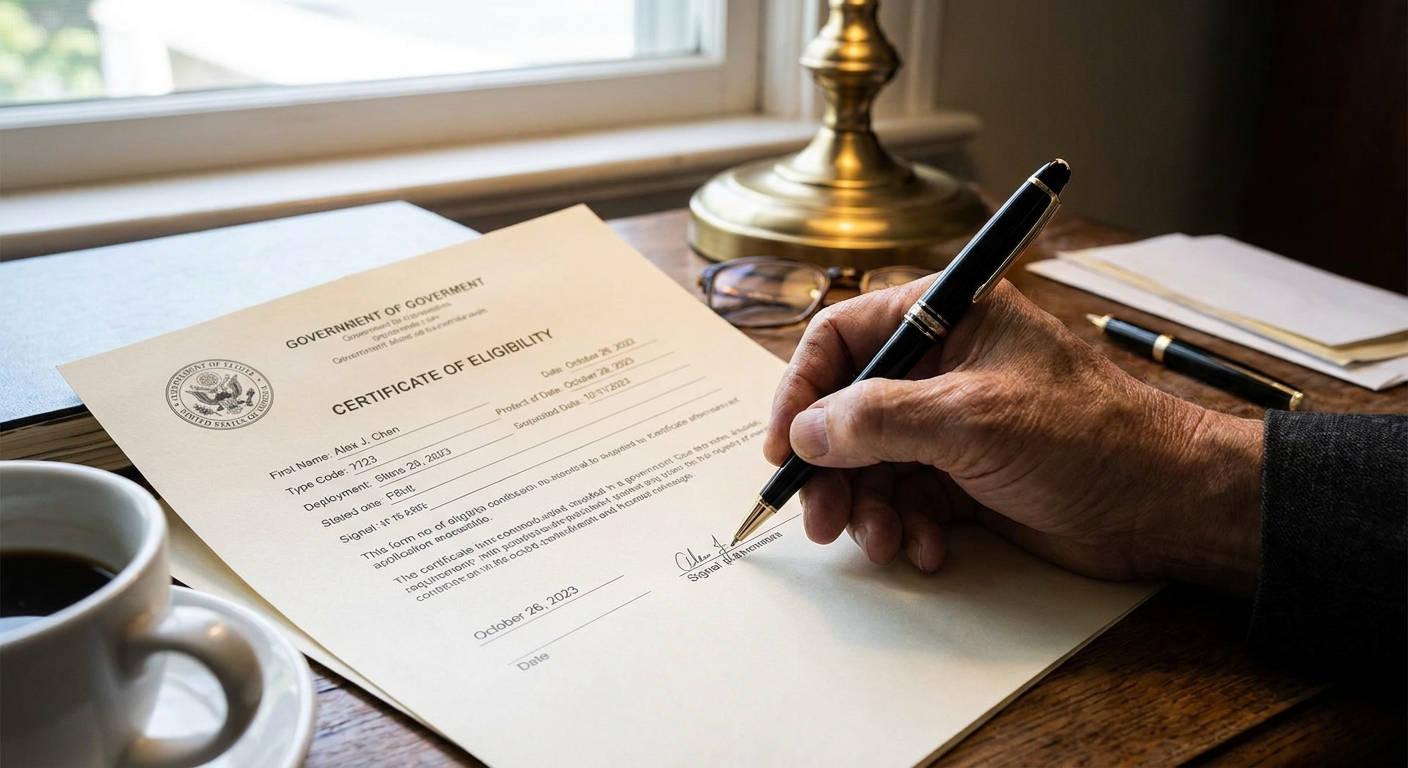
Use this pre-COE checklist
- Confirm who will be on the loan (just you, you and a spouse, co-borrower rules).
- Gather service documentation that may be needed for eligibility verification (exact documents vary by service status).
- Know your basic budget numbers: monthly income, debts, and a comfortable housing payment range.
- Check your credit reports for errors you can dispute before underwriting.
- Estimate your cash-to-close even if you plan on zero down (earnest money, appraisal, inspections, moving costs, reserves).
- Decide how you would handle the funding fee (pay upfront vs finance it, and whether you may qualify for an exemption).
- Pick two to four VA-experienced lenders to compare rates and fees apples-to-apples.
- Be ready with a realistic timeline for house hunting and closing, especially if you have a lease end date or PCS window.
If you want a simple next step: get a preapproval from a VA-savvy lender, request your COE through them (or directly through the VA if you prefer), then compare the Loan Estimate against at least one other lender before you pick your final loan.
VA home loan benefits FAQ
Can I use a VA loan more than once?
Often, yes. Many borrowers restore and reuse entitlement after selling and paying off the prior VA loan. Some borrowers can also use remaining entitlement for another primary residence, depending on the numbers and how much entitlement is still available.
Does a VA loan require perfect credit?
No. The VA does not set a single minimum credit score across the board, but lenders can and do set their own requirements. Strong income and manageable debt can help, even if your credit is not pristine.
Is zero down always the best move?
Not always. Zero down preserves cash, but it can increase your monthly payment and your total interest paid. If putting 5% to 10% down still leaves you with a healthy emergency fund, it can be worth running both scenarios. Also, if you have partial entitlement, a down payment may be part of the deal.
Do VA loans have mortgage insurance?
VA loans generally do not have monthly mortgage insurance like PMI. However, many borrowers pay a VA funding fee, which is a different cost structure.