
If budgeting feels like trying to juggle water, you're not alone. For years, I kept everything in one checking account and wondered why I was always surprised by “random” expenses. Spoiler: they weren't random. They were predictable; I just didn't have a clean way to separate money I could spend from money I already owed and money I'd need soon.
Using multiple bank accounts is one of the simplest ways to make your budget feel obvious. Not restrictive. Not complicated. Just clear. Think of it like organizing your kitchen. When everything is in one drawer, you overbuy and you can't find what you need. When each tool has a spot, dinner gets easier.

Why multiple accounts work
This strategy is basically “budgeting with guardrails.” Instead of relying on willpower to remember what your checking balance needs to cover, you create separate containers with specific jobs.
- Less mental math: Your Bills account balance isn't pretending to be available money.
- Fewer overdrafts and late fees: This setup can reduce them because bills get funded on purpose, not by hope.
- Clear guilt-free spending: If it's in the Spending account, it's the money you've decided is okay to spend after your priorities are funded.
- Sinking funds become real: You can see progress without mixing it with emergency savings or rent money.
And yes, you can do this even if you're starting with $50 in breathing room. The system scales.
The core setup: 2 checking + 2 savings
You can go as simple or as detailed as you want, but most people do great with four accounts. If your bank allows multiple sub-savings accounts or buckets, even better.
Checking Account #1: Bills
This account is for boring stuff, which is a compliment. Think rent or mortgage, utilities, car payment, insurance, childcare, minimum debt payments, subscriptions you keep on purpose, and anything that hits every month.
- Run as many bills as possible on autopay from this account.
- Keep a small buffer (for example, $100 to $300) so timing quirks don't bite you. If your bills are larger or your timing is tight, make the buffer bigger.
Checking Account #2: Spending
This is your day-to-day account or debit card account. Groceries, gas, coffee, dining out, fun money, Target runs, and “I forgot I needed this” moments.
Here's the rule that makes this magical: if it's not in the Spending account, it's not spendable.
Savings Account #1: Emergency Fund
This is for true surprises: job loss, medical expenses, urgent travel, a car repair that can't wait. Not holidays. Not a new phone. Not annual fees you knew were coming.
If you're building from scratch, aim for:
- Starter: $500 to $1,000
- Next: one month of essential expenses
- Long-term: three to six months (more if your income is irregular)
Practical note: some people keep a small piece of their emergency fund in checking for instant access, then the rest in a high-yield savings account.
Savings Account #2: Sinking Funds
Sinking funds are savings buckets for expenses you know are coming, just not monthly. This is the category that used to wreck my budget and make me feel like I was failing.
Common sinking funds:
- Car maintenance and registration
- Holidays and gifts
- Back-to-school
- Annual subscriptions
- Home repairs
- Medical deductible
- Travel

Pick sinking funds
The fastest way to quit this system is to open 17 accounts on day one and then feel behind everywhere. Start small and add only when you're consistent.
Step 1: List non-monthly expenses
Look back 3 to 12 months. Your bank statements are a treasure hunt for the truth. Write down every expense that shows up quarterly, semi-annually, or annually.
Step 2: Choose 3 to 5 funds
Pick the ones that:
- Hit you the hardest emotionally or financially
- Are coming up soon
- Are truly predictable
Step 3: Calculate the monthly amount
Use this simple formula:
Monthly amount = Cost ÷ Number of months until you need it
Example: If car insurance is $720 every 6 months, you set aside $120 per month.
Fund it like a flow
This is the part that turns “multiple accounts” into an actual budget. Your paycheck needs a plan for where it lands next.
Option A: Split direct deposit
If your employer lets you split your paycheck, you can send money straight where it belongs:
- Bills checking: fixed amount per paycheck
- Spending checking: weekly or per-paycheck amount
- Emergency savings: small automatic amount
- Sinking fund savings: total of your sinking fund monthly targets
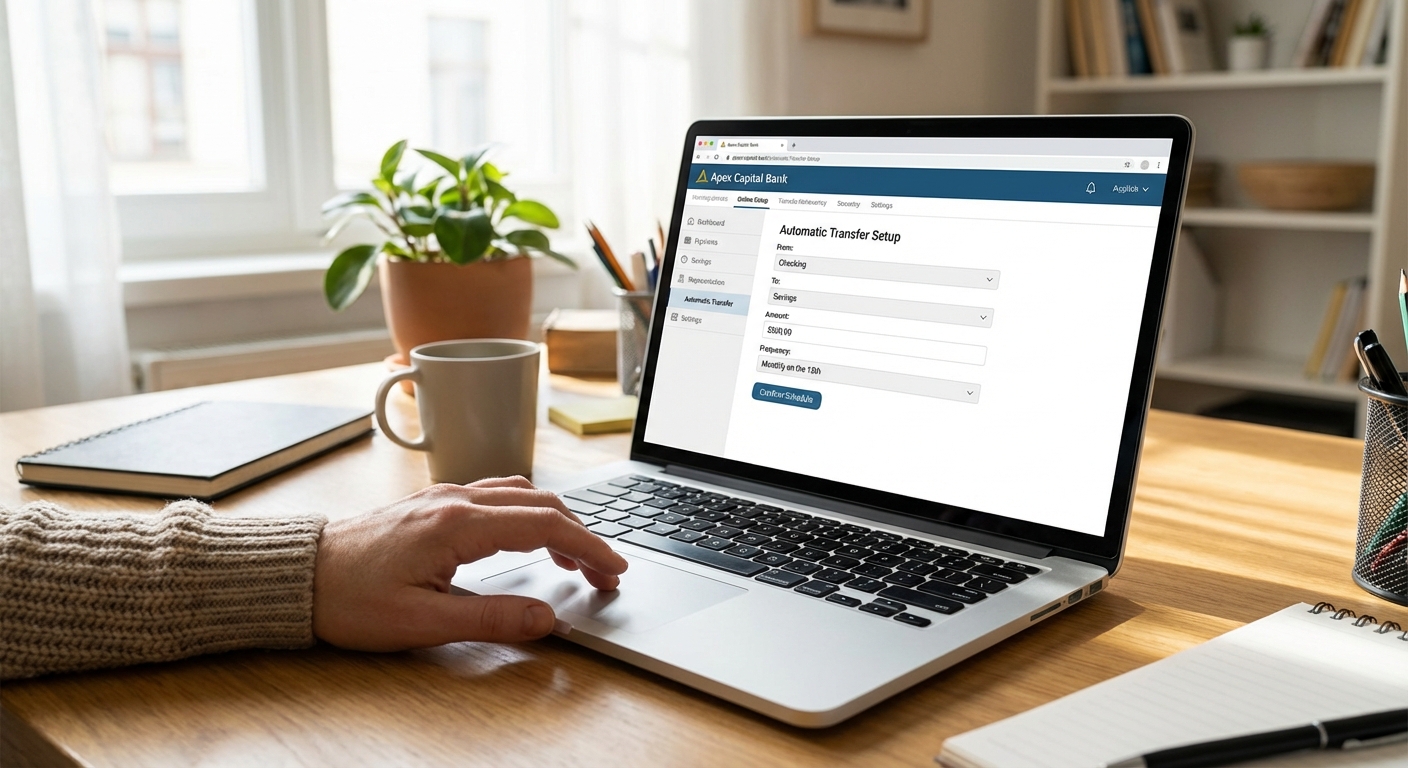
Option B: Automatic transfers
If your paycheck goes into one account, schedule automatic transfers for the day after payday. I like “day after” because deposits and posting times can be weird.
Also, if you're moving money across different banks, transfers can take 1 to 3 business days. Keep near-term bill money in the Bills checking so you're not playing transfer roulette.
A simple cadence:
- Payday + 1 day: move money to Bills and Sinking Funds
- Weekly on Friday: move a set amount to Spending
An example you can copy
Let's say your take-home pay is $4,000 per month, paid twice per month ($2,000 each paycheck).
- Bills checking: $1,400 per month ($700 per paycheck). This includes fixed bills and minimum debt payments.
- Spending checking: $1,200 per month ($600 per paycheck, or $300 per week)
- Sinking funds savings: $300 per month
- Emergency savings: $200 per month
- Leftover: $900 per month for extra debt payoff, investing, or bigger goals
The numbers aren't the point. The point is that each dollar gets a job before you have a chance to wonder where it went.
Track sinking funds in one account
Some banks let you create named buckets. Some don't. Either way, you can still track sinking funds cleanly.
If your bank supports buckets
Use one savings account and separate buckets like “Car,” “Holidays,” and “Home.” Set automatic transfers into each bucket if the bank allows it.
If your bank doesn't support buckets
Keep one Sinking Funds savings account and track the breakdown in a simple spreadsheet or notes app.
My low-stress approach:
- One row per sinking fund
- Columns for goal amount, monthly contribution, current balance
- Update once a week or once per payday
If you're a fellow color-coded spreadsheet person, this is your time to shine.
Credit cards and this system
If you use a credit card for points or protection, you can still keep the clarity:
- Keep day-to-day purchases within your Spending limit, even if they're charged to a card.
- Pay the card from Bills checking (or a separate “Card Payment” checking if you want to get fancy), but only using money you've already set aside for spending.
The goal is simple: the card is a payment tool, not a second Spending account.
Choose accounts without hassle
You don't need the “perfect” bank lineup to start. You need a setup you'll actually use.
What to look for
- No monthly fees (or fees that are easy to waive)
- No weird minimums for extra checking accounts, if you're opening more than one
- Easy transfers between accounts
- Solid mobile app with instant balance visibility
- High-yield savings for Emergency and Sinking Funds (with the understanding that rates change and access can vary)
- FDIC or NCUA insurance
One more practical note: if you're using a fintech app, confirm the insurance applies to your specific account structure, not just the app branding.
One bank vs multiple banks
- One bank is simpler: faster transfers, fewer logins, easier automation.
- Multiple banks can be powerful: keeps savings out of sight and reduces temptation, plus you can chase better savings rates.
My personal bias: one checking bank for daily life, one high-yield savings bank for Emergency and Sinking Funds. Clean and effective.
Common mistakes
Mistake: Using the Bills account for “just this one thing”
That's how the system breaks. If Spending is empty, you either pause spending or you intentionally move money over and accept the tradeoff.
Mistake: Forgetting irregular bills
If your Bills account keeps getting surprised, it usually means you're missing quarterly or annual items. Move those into Sinking Funds.
Mistake: Too many accounts too soon
Start with 2 checking and 1 savings if you need to. Add the Sinking Funds savings when you have the rhythm.
Mistake: Not reconciling reality
Once per month, do a 10-minute check-in:
- Are bills increasing?
- Is spending realistic?
- Are sinking funds actually covering the non-monthly stuff?
Quick start checklist
- Open or rename accounts: Bills, Spending, Emergency, Sinking Funds
- List all monthly bills and total them (include minimum debt payments so you don't double-count)
- Pick 3 to 5 sinking funds and calculate monthly amounts
- Set direct deposit splits or automatic transfers
- Put bills on autopay from Bills checking
- Move weekly spending to Spending checking
- Do one monthly 10-minute review
If you want the biggest win with the least effort, start with just this: separate your Bills money from your Spending money. That one move alone can take your anxiety down a notch fast.
And if you're coming out of a rough season financially, hear me on this: needing structure doesn't mean you're bad with money. It means you're building a system that supports the life you're trying to live.