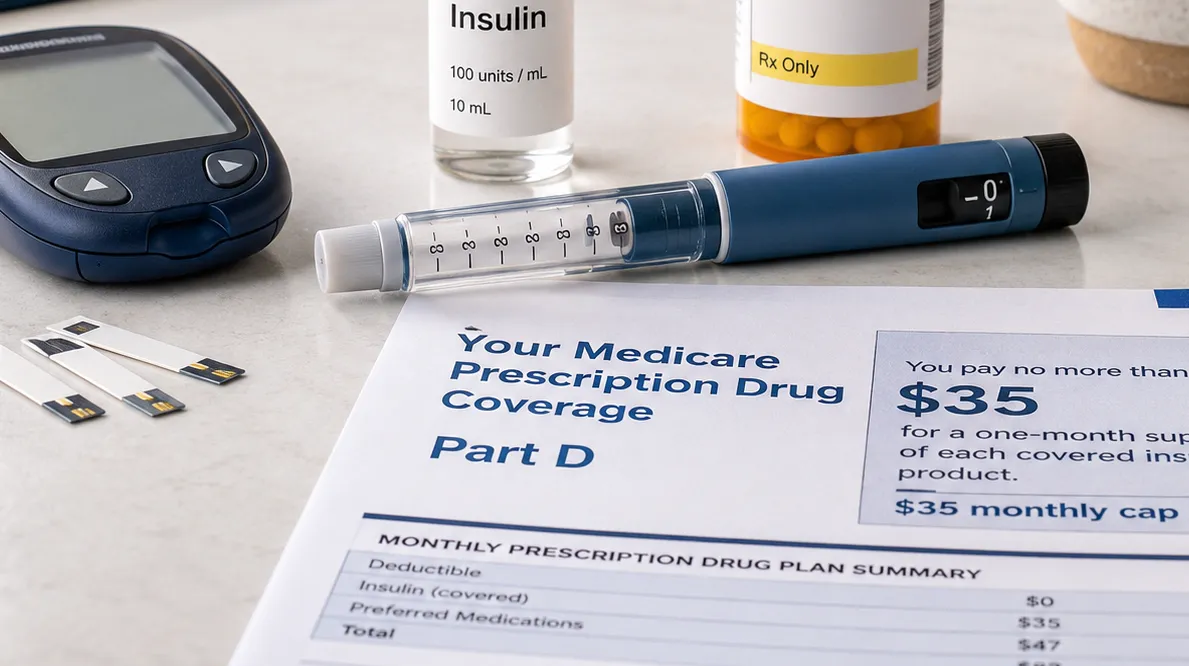
If you have diabetes and you are on Medicare, you have probably heard some version of: “Your insulin is capped at $35.” That statement is often true, but it can also be confusing because insulin is covered under different parts of Medicare depending on how you take it, and because the rules have changed in recent years.
As of 2023 (and still in effect now), the clean way to think about it is this: Part D generally covers insulin you pick up at the pharmacy for injections (vials, pens) and many newer delivery options, while Part B can cover insulin that is used through a Medicare-covered durable medical equipment (DME) external insulin pump. The $35 monthly limit can show up in both places, but the billing, the supplier or pharmacy setup, and what else you pay for are not identical.
Part B vs Part D
If you only read one section, make it this one. The biggest source of surprise bills is assuming your insulin is being processed under one part of Medicare when it is actually being processed under the other.
| Topic | Part D insulin limit | Part B insulin limit |
|---|---|---|
| Where you usually get it | Retail or mail-order pharmacy | Billed as durable medical equipment (DME), often through a DME supplier or pharmacy acting as DME |
| Typical use | Insulin for injections (vials, pens) and other pharmacy-dispensed insulin covered by your plan | Insulin used with a Medicare-covered DME external insulin pump |
| How the limit is applied | Your out-of-pocket cost for a covered insulin product is capped at $35 for a 1-month supply | Your cost-sharing for covered pump insulin is limited so your portion is no more than $35 for a 1-month supply |
| What the limit is about | Insulin only that is covered under Part D and on your plan’s formulary | Insulin only that is covered under Part B because it is used in a DME pump |
| What can still cost extra | Needles, syringes, alcohol swabs, glucose supplies, device supplies not covered by your plan | Pump, infusion sets, reservoirs, tubing, other pump supplies subject to Part B rules and supplier billing |
What the $35 limit covers
What “$35” usually means
In plain English, the limit is about your out-of-pocket cost for the insulin itself for a 1-month supply, as long as that insulin is covered under the correct part of Medicare for how you use it.
It does not automatically mean:
- All diabetes supplies are $35 a month
- Any insulin brand you want is $35
- Your pump supplies are included in the $35
One high-stakes nuance: for covered Part D insulin, plans generally cannot require you to pay the Part D deductible before the $35 monthly cap applies. Processing errors happen, though, so if the price looks wrong, treat it like a fixable billing issue and ask the pharmacy or plan to review the claim.
Common items outside the limit
This is where people get burned at the pharmacy counter. The insulin might be capped, but the extras add up.
- Pen needles (often Part D, but may have separate cost-sharing from insulin)
- Syringes for vial insulin
- Alcohol swabs, sharps containers, and other over-the-counter items
- Continuous glucose monitor (CGM) supplies and test strips (Part B coverage depends on Medicare eligibility criteria and whether the CGM is covered as DME; Part D may cover some supplies if they are not covered under Part B)
- Insulin pump supplies like infusion sets, cartridges, reservoirs, or tubing (these are not insulin, even when the insulin itself is capped)
- Non-formulary insulin (if your plan does not cover a specific insulin, the cap does not force coverage)

Part D insulin
Medicare Part D is the prescription drug benefit, either through a stand-alone Part D plan or a Medicare Advantage plan with drug coverage. (Medicare Advantage plans still follow Part D rules for the insulin cap, but networks and prior authorization rules can differ.)
In general, the Part D $35 limit applies when:
- You are enrolled in a Part D plan.
- The insulin is covered by your plan and appears on its formulary.
- You are filling the prescription in a way the plan treats as a covered Part D drug (pharmacy network rules matter).
Formularies still matter
I wish Medicare rules worked like a simple coupon you could use on anything. They do not. Your plan’s formulary decides what is covered, and insulin is usually grouped into tiers with preferred and non-preferred options.
The limit helps most when you are already using a formulary-covered insulin. If your doctor prescribes an insulin that is not on the formulary, you may need to:
- Ask your doctor about a therapeutic alternative that is covered.
- Request a formulary exception.
- Check if the plan requires prior authorization or step therapy.
What to verify
When you log into your plan portal or look up your drugs during enrollment, check these specific details:
- Exact insulin name (brand and formulation), not just “insulin.”
- Dosage form (vial vs pen).
- Strength and package size (plans sometimes prefer specific package configurations).
- Restrictions (prior authorization, quantity limits, step therapy).
- Pharmacy network (preferred pharmacy can matter even if the insulin is capped).
- Days’ supply rules: the limit is based on a 1-month supply. If you fill 60 or 90 days at once, your cost may be 2 times or 3 times $35 depending on how your plan processes the claim.
Also worth knowing: if you qualify for Extra Help (the Low-Income Subsidy), you may pay less than $35 for covered insulin.
Part B insulin and pumps
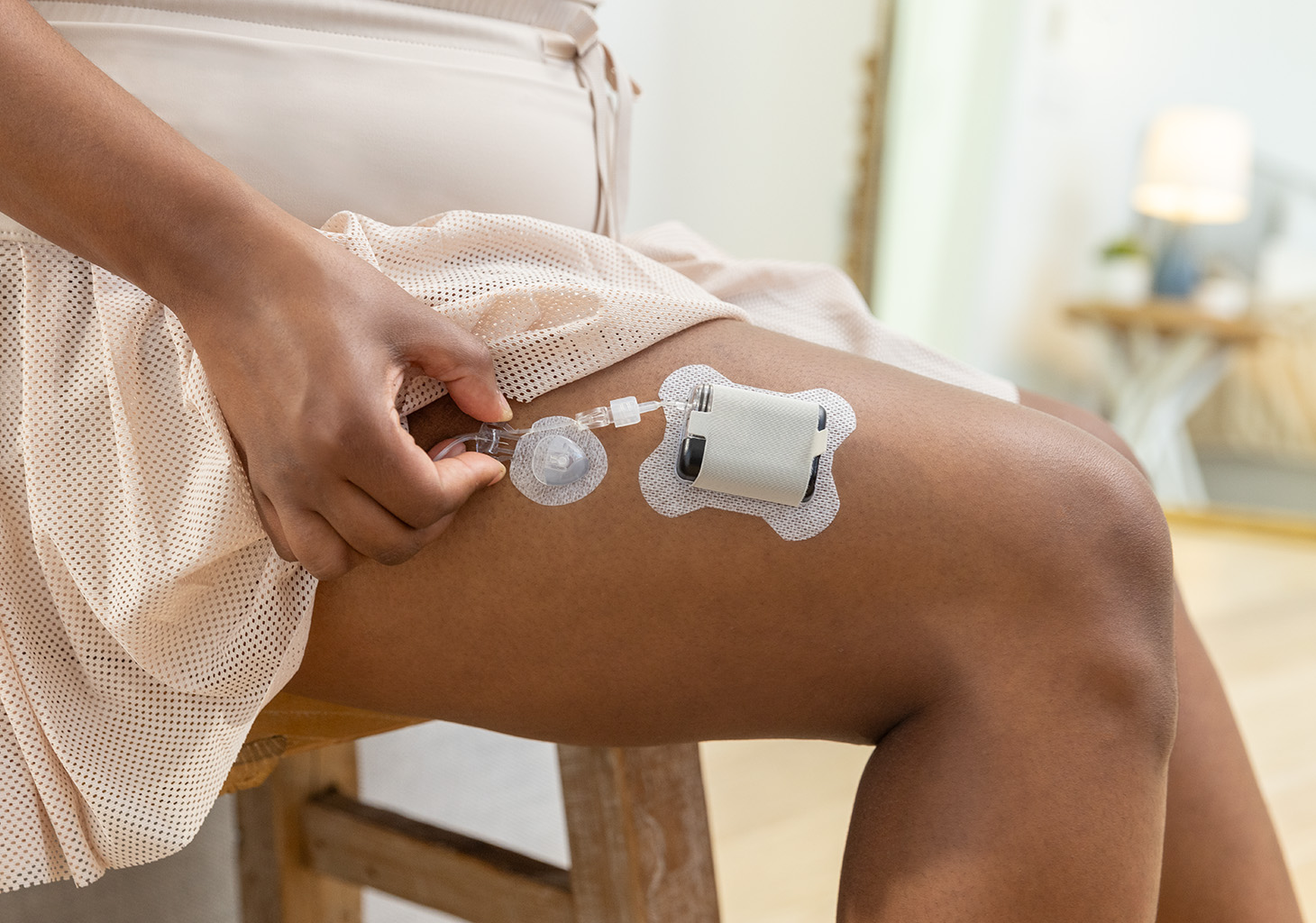
Medicare Part B is medical insurance. Insulin can be covered under Part B when it is used with a Medicare-covered DME external insulin pump and billed as DME-related.
Part B insulin is the classic “Wait, why did my insulin stop going through Part D?” moment. The answer is usually: because the insulin is being billed through a DME supplier (or a pharmacy acting as a DME supplier) as part of pump therapy, not as a standard pharmacy drug claim.
One more precision point that saves headaches: Part B pump insulin usually means insulin used in a traditional external insulin pump that Medicare covers as DME. Some disposable or patch-style pumps and their insulin arrangements can be covered differently, including under Part D in some situations. If you use anything other than a traditional external DME pump, ask how the claim will be billed before you refill.
What the limit includes under Part B
Under Part B, the limit is still about the insulin itself for a month’s supply when it is covered under Part B due to pump use.
What is outside the limit under Part B
Even if your pump insulin is capped, you can still have separate cost-sharing for:
- The pump (if you are renting, repairing, or replacing it)
- Infusion sets, tubing, reservoirs, cartridges, and other pump supplies
- Supplier pricing if you do not use a Medicare-enrolled supplier, or if the supplier does not accept assignment (which can lead to higher charges or balance billing)
Two quick checks
- Confirm how your insulin is being billed. Ask: “Is this insulin going through Part D at the pharmacy, or through Part B as DME pump insulin?”
- Confirm the supplier setup. For Part B, use a Medicare-enrolled supplier and, when possible, one that accepts assignment.
Why you might pay more
Here are the most common real-life reasons someone pays more than expected:
- Wrong Medicare bucket: The insulin is being billed under Part B when you expected Part D, or vice versa.
- Not covered by the plan: Under Part D, if the insulin is non-formulary, the limit does not help until it is covered.
- Supply costs: Needles, syringes, pump supplies, and related items are not insulin.
- Days’ supply and quantity issues: If the claim is not processed as a 1-month supply, the pharmacy or plan may price it differently.
- Pharmacy or supplier problems: Out-of-network pharmacies for Part D, or DME suppliers that are not Medicare-enrolled or do not accept assignment.
If you are charged more
If the register price is higher than you expected, do not just assume the limit “doesn’t apply.” A lot of overcharges are fixable with a reprocessed claim.
- Ask how it was billed (Part D vs Part B) and whether the pharmacy or supplier has your coverage on file correctly.
- Check the days’ supply on the label and claim (30 vs 60 vs 90 days matters).
- Confirm the exact covered product (the specific insulin formulation and package size). If the plan treats it as non-formulary, ask what the preferred covered alternative is.
- Request a re-run or reprocess if the pharmacy says the claim rejected or priced incorrectly.
- If it is a coverage issue, ask your plan about a formulary exception, prior authorization, or an appeal or grievance process.
- Use the paper trail: your plan’s Explanation of Benefits (EOB) or your Medicare Summary Notice (MSN) can help confirm whether it ran under Part D or Part B.
My checklist
When I was digging out of debt, one of the most expensive habits I had was assuming a bill would work out because it “should.” Health coverage is the same way. A couple of phone calls can save you real money.
- Look at your last claim or receipt and identify whether insulin was processed under Part D or Part B.
- Pull your plan’s formulary and search the insulin by exact name.
- Check for restrictions like prior authorization, step therapy, and quantity limits.
- Ask what counts as a 1-month supply for your prescription and whether 90-day fills price as 3 separate capped months.
- If you use a pump, confirm whether it is treated as a Part B DME external pump and who the approved supplier is.
FAQ
Is every insulin brand capped at $35 on Medicare?
No. The limit applies to covered insulin under the applicable Medicare part. Under Part D, that means insulin on your plan’s formulary. Under Part B, it means insulin covered as part of DME pump therapy. If it is not covered, the limit does not force coverage.
Does the $35 limit include pen needles and syringes?
Typically, no. The limit is focused on the insulin itself. Needles, syringes, swabs, and other supplies can have separate coverage and cost-sharing.
If I have a pump, is my insulin Part B or Part D?
It depends. If you use insulin with a Medicare-covered DME external pump and it is billed through a DME supplier, it is often Part B. Other pump types and insulin arrangements can be billed differently, so the safest move is to ask how your insulin is being billed before your next refill.
What should I ask my Part D plan about insulin?
Ask whether your specific insulin (exact name, vial vs pen, strength) is on the formulary, whether it has restrictions, what they consider a 1-month supply for pricing, and which pharmacies are preferred in-network.
Bottom line
The $35 insulin limit is real help, but it is not magic. The key is keeping two rules separate in your head:
- Part D: pharmacy-dispensed insulin that is on your plan’s formulary, with your out-of-pocket cost capped at $35 for a 1-month supply of each covered insulin product.
- Part B: insulin used with a Medicare-covered DME external insulin pump, with patient cost limited for a 1-month supply of covered insulin, while pump hardware and supplies can still be billed separately.
If you are not sure which side you are on, start with your last receipt or claim and follow the billing trail. That one step usually clears up most of the confusion.