
Money stuff gets weird with roommates for one reason: you are mixing friendship (or basic politeness) with real numbers and real deadlines. The good news is you do not need a perfect system. You need a clear system that everyone understands, agrees to, and can actually follow when life gets busy.
This guide covers the most common ways to split rent and bills, how to handle utilities and irregular costs, what to put in a simple written agreement, and a few neutral scripts you can copy and paste when the conversation feels awkward.
Quick note: This is practical guidance, not legal advice. Lease rules and local laws vary, so treat your lease and your landlord’s policies as the source of truth and document your roommate plan separately.

Start with one decision: what are you splitting?
Before you pick a method, list the expenses you will share. Most roommate conflict happens because people assume different things are included.
Common shared expenses
- Rent
- Utilities: electric, gas, water, sewer, trash
- Internet (and cable if you still have it)
- Household supplies: toilet paper, paper towels, dish soap, cleaning supplies
- Optional: streaming services, parking, renter’s insurance add-ons, a shared meal fund
Not shared (unless you explicitly agree)
- Personal groceries and takeout
- Personal subscriptions
- Personal toiletries
- Furniture purchases one person will keep
Quick win: Write two lists: “Shared” and “Not shared.” If something is not on the shared list, it is not shared.
3 fair ways to split rent
There is no universal “fairest” method. Fair is what matches your apartment setup and your roommate dynamics. Here are the big three models people use.
Method 1: Split rent equally
Best for: Similar room sizes, similar perks, and roommates who value simplicity.
How it works: Total rent ÷ number of roommates.
- Example: $2,100 rent with 3 roommates = $700 each
Pros: Easy, fast, minimal math.
Cons: Can feel unfair if one room is much larger, has a private bathroom, or includes parking.
Method 2: Split rent by room size or perks
Best for: One room is clearly “better” (bigger, private bath, balcony, better light) or one roommate gets an extra perk like a reserved parking spot.
Two simple ways to do it:
- Square footage approach: Bedrooms are weighted by size. Common areas are usually treated as shared equally.
- Perk pricing approach: You agree that certain perks are worth a flat amount (example: “Private bathroom is worth $100/month”).
Example (perk pricing): Rent is $2,400. Roommate A has the primary bedroom with private bath. You agree that perk is worth $150/month.
- Roommate A pays $950
- Remaining $1,450 is split between B and C = $725 each
Pros: Aligns cost with what each person gets.
Cons: Requires negotiation and a clear agreement upfront.
Method 3: Income-based rent split
Best for: Roommates with significantly different incomes who want to keep the home affordable for everyone.
How it works: Each person pays rent proportional to their income. A basic approach uses gross monthly income, but you can also use take-home pay if everyone prefers it.
Example: Rent is $2,000.
- Roommate A earns $4,000/month
- Roommate B earns $3,000/month
- Roommate C earns $3,000/month
Total income = $10,000.
- A pays 40% of rent = $800
- B pays 30% of rent = $600
- C pays 30% of rent = $600
Pros: Can be the most “life-fair” when incomes vary.
Cons: Requires sharing income info, and it can feel uncomfortable or too personal.
My take as a value-spender: If you choose income-based, keep it simple, agree on which income number you are using, and do not turn it into a morality play. It is a housing math choice, not a character judgment.
One more practical note: Some landlords only accept one payment. If that is your situation, decide who pays the landlord, when everyone sends their share (earlier than the landlord due date), and what happens if someone is late.
How to split utilities
Once rent is settled, utilities are the next friction point, because usage changes month to month. The best system is usually the one that prevents repeated debates.
Option A: Split utilities equally
Best for: Similar schedules and similar usage.
How it works: Each bill ÷ number of roommates.
Why it works: Low friction, easy to track.
Option B: Split utilities by “weighted use”
Best for: One roommate works from home all day, someone runs a space heater nonstop, or one person is barely home.
Simple approach: Keep most utilities equal, but weight the biggest driver.
- Example: Internet is equal. Electric is weighted 50% equal, 50% by usage factors (work-from-home, AC preferences).
Tip: Avoid trying to precisely measure everything. A lightweight weighting system beats a monthly courtroom drama.
Option C: Set a utilities “cap” with true-up
Best for: Groups that want predictable monthly costs.
How it works: You each pay a set amount (example: $120/month) into utilities. If the bills come in under, you roll the extra forward. If they come in over, you split the difference at the end of the quarter.
Where the money sits: Either one roommate holds it and tracks it transparently, or you keep a separate account earmarked for bills (if your bank makes that easy). The key is that everyone can see the math.
Why it works: It smooths out seasonal spikes without constant renegotiation.
My take as a value-spender: If you do a cap, pick a number that is slightly conservative for your highest-bill season. Your future selves will thank you.
Irregular bills and surprises
Irregular expenses are the landmines. The easiest way to defuse them is to agree in advance which category they fall into.
Common irregular expenses and how to handle them
- Security deposit: Follow the lease and any local rules. Deposits are commonly returned to the named tenant(s), not “the household,” so keep your internal split and return plan written down separately.
- Application/admin fees: Often split equally per applicant, but follow the landlord’s policy and your lease paperwork.
- Move-in costs (truck, supplies): Either “everyone chips in” or “each person covers their own.” Decide early.
- Damage and repairs: Separate normal wear from someone-caused damage. Normal wear is shared, someone-caused damage is paid by the person responsible. If responsibility is unclear, agree on a default rule (example: split it, or treat it like a shared cost unless someone volunteers responsibility).
- Furniture for shared spaces: Only split if everyone agrees on the item, the budget, and who keeps it if someone moves out.
Move-in and move-out proration (do this once)
If someone moves in mid-month, moves out early, or you switch roommates, decide how you will prorate costs so nobody is doing case law in the group chat.
- Rent proration: Usually rent ÷ days in the month × days occupied, unless your lease says otherwise.
- Utilities timing: Many households keep utilities on the “billing cycle” instead of trying to slice it perfectly. You can also use a simple split: outgoing roommate pays through their move-out date, incoming roommate starts the next day.
- Deposit handoff: If a new roommate replaces someone, it is common for the new roommate to buy out the departing roommate’s deposit portion (then the lease deposit stays intact). Write it down.
A simple shared-house fund (my favorite)
If you want fewer Venmo requests, set up a small monthly “house fund” for shared supplies and minor one-off costs.
- Example: $25 to $50 per person per month
- Use it for: trash bags, cleaning spray, light bulbs, batteries
- Track it in one app or spreadsheet so everyone can see where it went
Important: Decide who holds the fund, what receipts you keep, and what happens if someone moves out with money still in it.
Apps to split bills
You do not need fancy tools, but you do need a system that is visible and easy to use. These are popular options that work well for roommates.
Splitwise
- Best for: Ongoing shared expenses with lots of small items
- Why people like it: Tracks who owes what over time, not just one bill
- Good fit for: Groceries, supplies, shared takeout, uneven splitting rules
Venmo or PayPal
- Best for: Paying each other quickly
- Why people like it: Familiar, fast, easy reminders
- Watch for: It is payment, not full accounting. Add a note like “April electric” so payments stay clear.
Zelle
- Best for: Bank-to-bank transfers without extra apps
- Why people like it: Often instant, no social feed
- Watch for: Less built-in tracking and categorization than dedicated split apps
Google Sheets (yes, really)
- Best for: Roommates who want transparency and control
- Why people like it: Custom rules, receipts, and a running balance
- Pro tip: Create tabs for “Rent,” “Utilities,” “House Fund,” and “One-offs.” Color-code by roommate.
Optional: If you are splitting by room size, a rent-splitting calculator can help you sanity-check numbers. You do not need a fancy one. You just need everyone to agree on the inputs.
A simple roommate money agreement
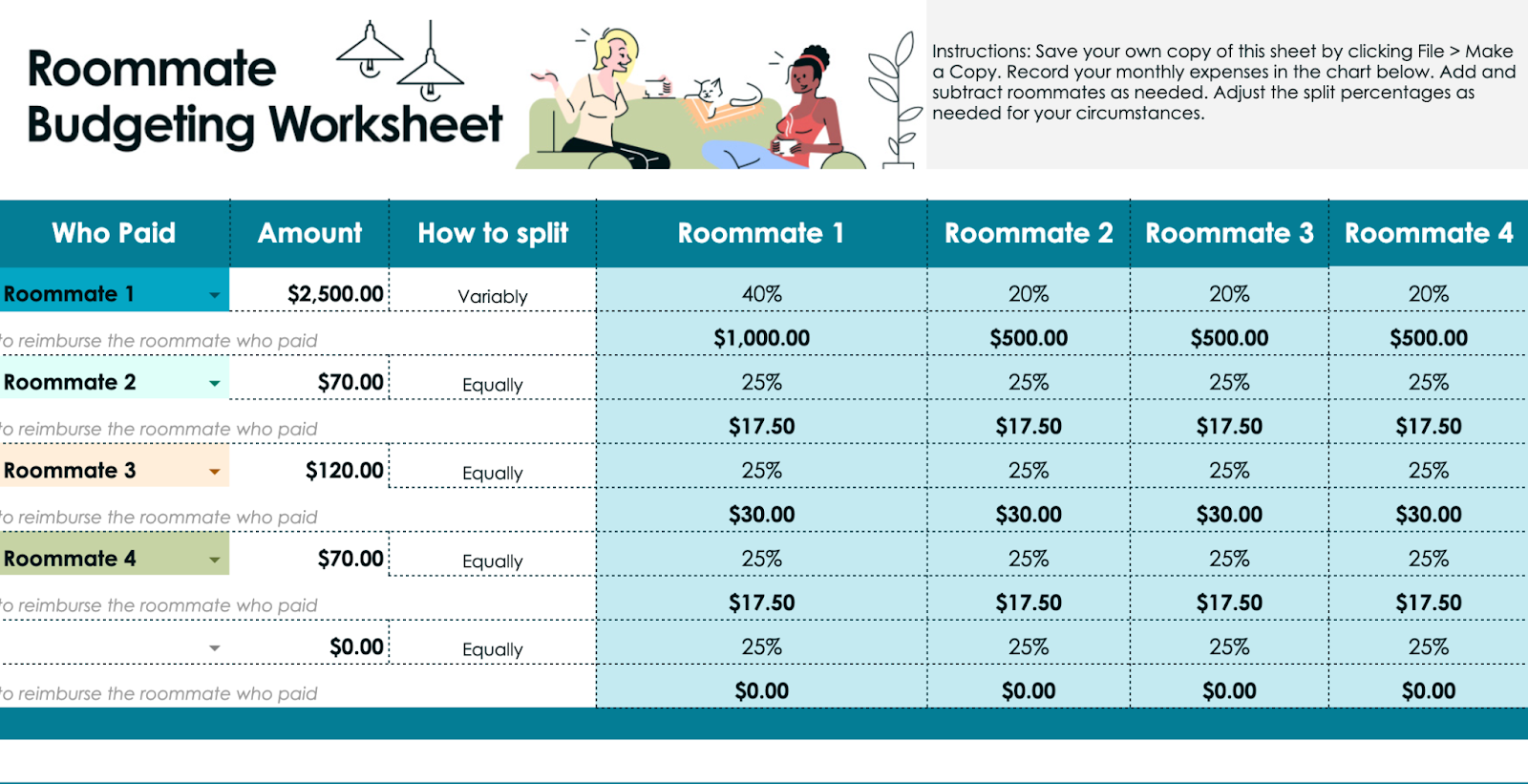
You do not need a legal masterpiece. You need a one-page agreement that stops misunderstandings. A shared Google Doc works great for this. Everyone can add their name and confirm in writing (even a simple “I agree” message), but keep in mind enforceability can vary by location and lease terms.
Agreement checklist
- Rent split method: equal, by room/perk, or income-based (include the exact numbers)
- Rent due date: landlord due date and your internal due date (example: “Everyone sends their share by the 25th”)
- How rent is paid: who pays the landlord, and how reimbursement happens (especially if the landlord requires one payment)
- Utilities list: which utilities are shared and how they are split
- Whose name is on each bill: and how reimbursements work
- Irregular expenses: deposits, move-in fees, repairs, replacement items
- Household supplies: shared list, monthly fund amount (if any), and purchase rules
- Late payment plan: grace period, reminders, any late fees, and what happens if someone cannot pay on time (communication timeline and a short-term plan)
- Move-out rules: notice period, replacement roommate process, proration approach, and how deposit return is handled
- Conflict plan: how you will raise issues (group chat, monthly check-in)
Small but powerful add-on: Add a line that says “We will revisit this agreement in 60 days and adjust if needed.” That gives everyone a pressure release valve.
Scripts for awkward money talks
If you freeze up around money talks, you are not alone. Here are neutral scripts that keep things calm and specific. Adjust the numbers and details to fit your situation.
Starting the conversation
“Hey, before we get fully settled, can we take 15 minutes tonight to agree on how we are splitting rent and utilities? I want to make sure it feels fair and that we all know the due dates so nobody gets stressed later.”
Proposing an equal split
“Since the rooms are pretty similar, I think the simplest option is splitting rent and utilities evenly. Rent is $2,100, so that would be $700 each. If anyone feels like there’s a big perk difference we should account for, I’m open to talking through it.”
Proposing a room-size or perk adjustment
“Because the primary bedroom has the private bathroom, would it feel fair if that room paid a bit more each month? For example, we could add $150 to the primary room, then split the rest evenly. If that number feels off, let’s pick something we all agree is reasonable.”
Proposing an income-based split
“I wanted to float an income-based rent split so the place stays affordable for everyone. If we use our monthly take-home pay percentages, we can calculate a split that matches income. Totally okay if that feels too personal, I just wanted to put the option on the table.”
Setting a utility plan
“For utilities, I’d love to keep it simple: we split them evenly and settle up once a month. If we notice one bill is consistently high, we can revisit after two billing cycles.”
Asking for money that is late
“Hey, quick reminder that the electric bill is due on Friday. Your share is $43.20. Can you send it by tomorrow night so I can pay it on time?”
Addressing repeat lateness
“I want to flag something before it becomes a bigger issue. The last couple bills have been late and it’s putting me in a tough spot since they’re in my name. What would make it easier for you to pay on time, a different due date, automatic payments, or switching whose name is on the bill (if the provider allows it)?”
Saying no to splitting a purchase
“I’m going to pass on splitting that, but I’m totally fine if you want to buy it for yourself. If we want to buy shared items together, can we agree on a budget first?”
Best practices that prevent a lot of drama
- Pick a dedicated money schedule. Example: settle everything on the 25th so rent is ready before the 1st.
- Keep receipts for shared purchases. Even a quick photo in a shared album works.
- Use clear payment notes. “May gas bill” beats “utilities” every time.
- Do not mix favors with bills. Cleaning the kitchen is great. It does not replace cash owed unless you agree to that explicitly.
- Revisit after 60 to 90 days. Your first plan is a draft. Adjust once you have real bill history.
One grown-up detail: If a bill is in one person’s name, late payments can create fees, shutoffs, and sometimes credit or collections risk for that person. That is not meant to scare anyone, it is just a reason to set earlier internal due dates and use autopay where possible.
Quick FAQ
Is it fair to split rent equally if rooms are different sizes?
It can be, but only if everyone agrees the difference is minor or balanced by another perk. If one room is clearly better, a small adjustment often prevents resentment later.
Should utilities be split the same way as rent?
Not necessarily. Many roommates split rent by room size but keep utilities equal because it is simpler and usage is hard to measure precisely.
What if one roommate refuses to pay?
Start with a calm written reminder and a specific deadline. If bills are in your name, protect yourself first: avoid racking up new shared charges you cannot cover, and see what options your provider and lease allow (some changes are not possible without fees or account changes). Document everything. If it escalates, follow your lease terms and consider mediation, your landlord, or other local resources.
Do we need a written agreement?
You do not need a formal contract for it to help. A one-page shared doc with the split method, due dates, and rules for irregular costs can save your living situation.
A simple “copy and decide” setup
If you want the fastest path to peace, here is a starter setup that works for most apartments:
- Rent: split equally unless one room has a major perk, then add a flat $50 to $200 adjustment
- Utilities: split equally
- Internet: split equally
- Supplies: $30/month per person house fund
- Tracking: Splitwise or a shared Google Sheet
- Money schedule: settle everything on the 25th so rent is ready before the 1st
The goal is not to win a fairness debate. The goal is to make your home feel stable and predictable, so you can focus on work, school, and actually enjoying the place you are paying for.