
Opening a joint bank account sounds like a simple milestone. In real life, it can feel like you are combining two different operating systems, each with its own spending habits, money fears, and definitions of what “reasonable” means.
I am a big fan of joint accounts when they are used with intention. The goal is not to merge money as a symbol of commitment. The goal is to make your shared life easier: bills get paid on time, savings grow automatically, and you both know where the money is going.

This guide walks you through the pros, cons, setup steps, and the best practices that keep joint accounts from turning into monthly arguments.
What a joint bank account is
A joint bank account is a checking or savings account owned by two or more people (most often two). In most cases, each owner can:
- Deposit money
- Withdraw money
- Use a debit card (for checking)
- Set up bill pay and transfers
- See the full transaction history
That “each owner can withdraw” part is the big deal. A joint account is a convenience tool, but it is also a shared legal arrangement. In many setups, the bank treats each owner as fully responsible for fees, negative balances, and what happens inside the account, even if one person made the transaction. The exact rules depend on how the account is titled and your state laws.
Common joint account types
- Joint checking: The workhorse for rent or mortgage, utilities, groceries, childcare, and shared subscriptions.
- Joint savings: The calm, boring account that funds the emergency fund, vacations, and big shared goals.
- Joint money market account: A savings-style account that may offer checks or debit access, often with higher balance requirements.
When a joint account makes sense
Joint accounts are most helpful when you have shared obligations that must be paid no matter who is busy, stressed, traveling, or forgetful this week.
- You live together and split core bills
- You are married or domestic partners
- You are saving for shared goals like a home, wedding, baby expenses, or travel
- One partner handles bill pay and you want full transparency
- You are tired of Venmo requests for groceries and internet
This guide is written for couples, but the same systems can work for other shared setups too, like roommates or caregiving situations. The key is trust plus clear rules.
If you are dating casually or you have not built trust yet, you can still share costs without sharing an account. A joint account is not the first step. It is usually a later step.
Pros of joint accounts
1) Simpler bill paying
One checking account means one place to pull money from for shared expenses. No more guessing whose card is on file for the electric bill or whether the rent got paid.
2) More transparency
When both people can see what is happening, it cuts down on anxious assumptions. The account becomes a shared scoreboard, not a secret diary.
3) Easier goal tracking
Saving for a vacation is cleaner when the vacation fund lives in one place and both people can see it grow.
4) Fewer transfers and split payments
Instead of constantly reimbursing each other, you can each contribute a set amount and just pay shared expenses normally.
5) Fewer overdrafts and late fees
If your bills are spread across multiple accounts, it is easier to miscalculate. One shared bills account can reduce the “oops, wrong account” problem.
6) More deposit insurance coverage
This is a practical perk people overlook. If your joint account is at an FDIC-insured bank (or NCUA-insured credit union), joint accounts are generally insured up to $250,000 per co-owner, per institution. For a two-person joint account, that typically means up to $500,000 in coverage for the joint funds. Coverage rules can get nuanced if you have multiple accounts at the same institution, so confirm your full setup if you keep large balances.
Cons and risks to know
1) Either person can drain the account
This is the risk nobody wants to talk about, but it matters. In many banks, both owners have equal access. If trust is shaky, keep shared money limited to shared bills only.
2) You may inherit each other’s money habits
If one partner is a spender and the other is a planner, a joint account can become a daily friction point unless you set boundaries.
3) Debt and legal issues can complicate things
Depending on your state, your account titling, and the source of funds, creditors may be able to levy money in a joint account if one owner has judgments, liens, or certain types of collections. If that is your situation, consider getting legal advice and keeping shared balances lower until you understand the risk.
4) Breakups are messier with shared money
Closing a joint account is doable. Untangling a joint account after months of mixed spending is what creates drama.
5) Privacy tradeoff
Joint means visible. If you want to surprise your spouse with a gift, you will need a plan that does not spoil it.
3 setups that work
There is no single “right” way to do this. Here are the systems I see work most often, from fully merged to mostly separate.
Option A: Fully joint
How it works: Paychecks go into one joint checking account. Bills, spending, and savings all flow from there.
- Best for: Couples with similar money habits and a shared approach to goals.
- Watch out for: One partner feeling monitored or losing a sense of autonomy.
Option B: Yours, mine, ours
How it works: You keep individual checking accounts for personal spending, plus one joint checking for bills and one joint savings for shared goals.
- Best for: Most couples, especially if spending styles differ.
- Why it works: Shared responsibilities are handled together, and personal spending stays personal.
Option C: Joint for one purpose
How it works: You open a joint savings for an emergency fund or a home down payment, but keep day-to-day spending separate.
- Best for: Couples easing into shared finances, or those who split bills in another way.
- Watch out for: Confusion if bills still bounce between accounts without a clear system.
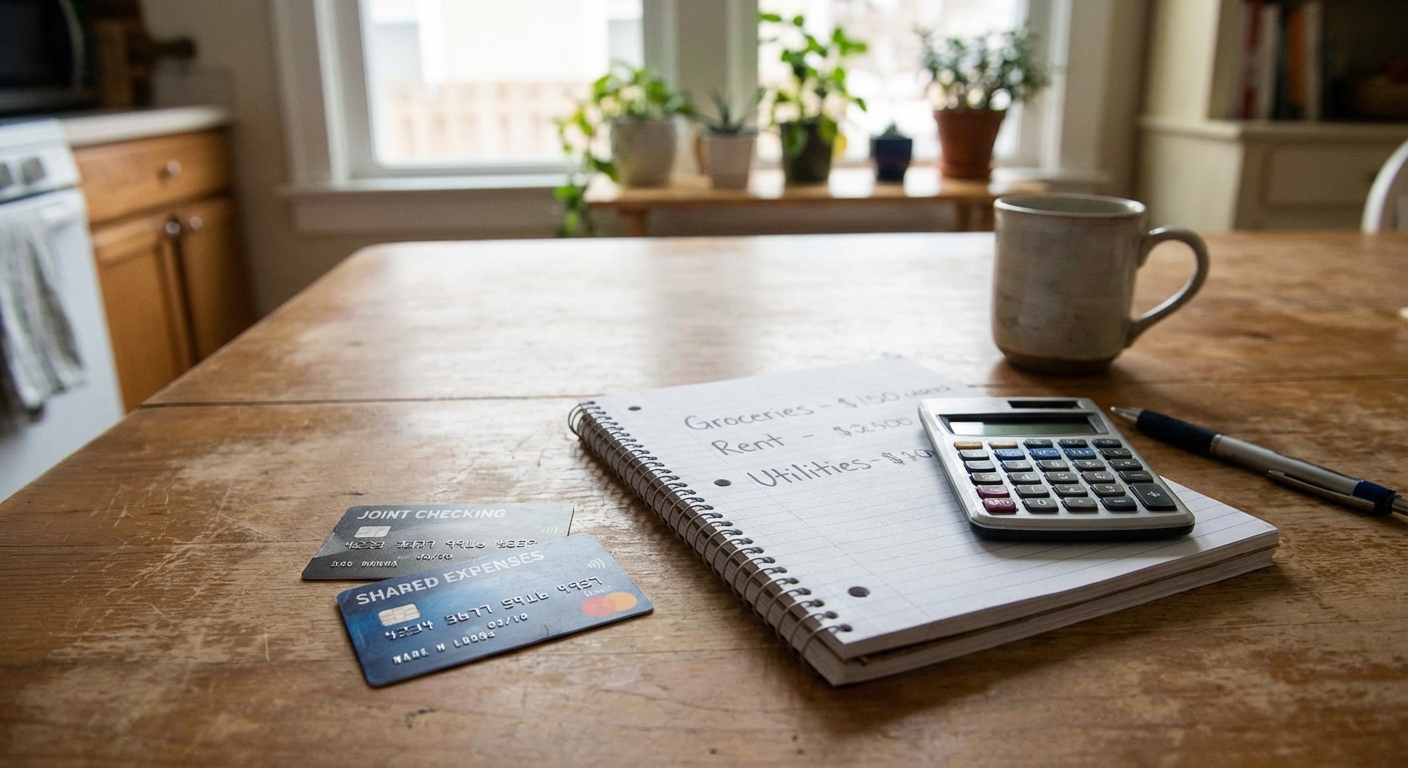
How to set up joint checking
Step 1: Agree on what it is for
Before you pick a bank, pick the purpose. For example:
- “This account pays rent, utilities, groceries, and insurance.”
- “This account is for our emergency fund only.”
Clarity prevents the classic fight: “I thought that was household money.”
Step 2: Choose the right features
For a joint checking account, prioritize:
- No monthly maintenance fee or an easy way to waive it
- Large fee-free ATM network if you use cash
- Strong mobile app with alerts and easy transfers
- Overdraft controls like declining transactions or low-balance alerts
- Free bill pay and easy recurring transfers
- Two debit cards (one for each owner) and easy card controls
For a joint savings account, prioritize:
- High yield (a competitive APY)
- No monthly fee
- Easy transfers to joint checking
Step 3: Decide your bills buffer
I like the “bills buffer” approach: keep about one month of shared expenses as a cushion. Example: if your shared bills and shared spending run about $3,000 a month, aim to keep $3,000 to $3,500 in joint checking so a late paycheck or higher-than-usual utility bill does not turn into a scramble.
Step 4: Open the account
You typically need:
- Government-issued ID for both people
- Social Security number or tax ID
- Current address and contact info
- Initial deposit (varies by bank)
When you open it, make sure both people are listed as full owners and both get online access. If one person cannot log in, it is not truly shared in practice.
Step 5: Set up income and transfers
You have two clean options:
- Direct deposit into joint checking (simple if you are fully joint)
- Automatic transfers from each person’s individual checking into joint checking (great for yours, mine, ours)
Step 6: Put bills on autopay and set alerts
Use autopay for the non-negotiables: housing, utilities, insurance, minimum debt payments. Then set:
- Low-balance alerts
- Large transaction alerts
- Overdraft alerts
How to set up joint savings
Joint savings works best when it is slightly inconvenient to touch. Not impossible, just not sitting next to your debit card.
Best practice: separate savings by goal
If your bank allows it, use multiple savings “buckets” or separate savings accounts for:
- Emergency fund
- Home repairs
- Vacation
- Car replacement
- Holiday gifts
When each goal has its own lane, you are less likely to raid the emergency fund for a weekend trip.
Automation that works
- Paychecks land in individual accounts (or joint, either way)
- A recurring transfer funds joint checking for bills
- Another recurring transfer funds joint savings the day after payday

Rules that prevent fights
1) Set a heads-up spending limit
Pick a number you both agree on, like $50 or $150. Any purchase above that from the joint account needs a quick heads-up first. This is not permission. It is teamwork.
2) Define “shared expenses”
Write a short list. Seriously. “Groceries” is shared. “My solo lunch every day” might not be. This one list prevents a lot of resentment.
3) Do a weekly 20-minute check-in
Not a full budget summit. Just:
- What bills are coming up?
- What is our balance?
- Any big expenses this week?
If you keep it short and consistent, money stops feeling like a surprise.
4) Keep personal spending personal
If you use the yours, mine, ours method, give each person their own guilt-free spending. When personal purchases come from personal accounts, the joint account stays peaceful.
5) Agree on overdraft policy
Decide together:
- Do we want transactions declined if funds are low?
- Do we link savings as overdraft protection?
- Who is responsible for fixing it the same day?
Overdrafts are expensive and emotionally annoying. Plan for them like adults, not like it will never happen.
Before you merge finances
Talk about these first
- Debt: balances, interest rates, minimum payments, payoff plan
- Credit scores: not as a judgment, but as a planning tool
- Money goals: home, travel, kids, career changes
- Spending triggers: stress spending, convenience spending, shopping as entertainment
- Family expectations: helping parents, gifts, holidays, obligations
If one person is rebuilding after debt
As someone who clawed my way out of consumer debt, here is what I can tell you: shame makes money harder, not easier. If one partner is recovering from a rough financial season, build a system that supports better habits without turning into surveillance.
Security and access
Shared visibility, not shared passwords
Each person should have their own login. Do not share a single username and password. If your bank does not support separate logins for joint owners, consider a different bank.
Turn on account alerts
- Low balance
- Large purchase
- Withdrawal
- New payee added
How the account is titled matters
Ask the bank how your joint account is titled. The most common setup for couples is Joint Tenancy with Right of Survivorship (JTWROS), which typically means that if one owner passes away, the funds go directly to the surviving owner and can bypass probate. Other titling options exist (and some states treat them differently), so do not guess. Confirm.
Beneficiaries and POD settings
Joint accounts often pass smoothly to the surviving owner when right of survivorship applies, but rules vary by account type and titling. Ask your bank how ownership, JTWROS, and any payable-on-death (POD) designations work for your specific account.
Keep notes for weird transactions
If you ever have to dispute a charge, having a paper trail reduces stress. A simple shared notes app works.
How to split contributions
“Fair” does not always mean “50/50.” Here are common approaches couples use.
Split 50/50
Works best when incomes are similar and both feel good about it.
Split by income percentage
If one person earns 60% of household income and the other earns 40%, you contribute 60/40 to shared bills and savings. Quick example: if shared bills are $3,000 a month, one partner contributes $1,800 and the other contributes $1,200. If you get paid twice a month, that could be $900 and $600 per paycheck, automatically transferred into joint checking.
Assign bills by category
One person handles rent, the other handles groceries and utilities. This can work, but it is often harder to track and can feel unfair if costs fluctuate.
If you want the least drama, choose a percentage split and automate transfers into joint checking. Predictable inputs create predictable outcomes.
If you break up or separate
Not romantic, but responsible: have a plan.
Quick checklist
- Move direct deposits and autopays to individual accounts
- Pause non-essential subscriptions tied to the joint debit card
- Download statements and transaction history
- Agree on how remaining balance is split
- Close the joint account and get written confirmation
If you are separating under stressful circumstances, consider keeping the joint account balance minimal and using it only for shared bills until everything is finalized.
FAQs
Should we open a joint account before marriage?
Some couples do, especially if they live together and share bills. If you do, keep it purpose-based: shared bills only, small buffer, no mixed personal spending.
Can we have a joint account and still keep separate accounts?
Yes, and it is often the sweet spot. Joint for the shared life. Separate for personal freedom.
Will opening a joint account affect my credit score?
Bank deposit accounts generally do not affect your credit score the way loans and credit cards do. However, banks may review your banking history through systems like ChexSystems or Early Warning Services when you open an account. Also, overdrafts that go unpaid can be sent to collections and can hurt your credit.
Is a joint savings account a good idea for an emergency fund?
Usually yes, if you both agree on what counts as an emergency and you keep the money in a high-yield savings account where it is safe and accessible.
Do we pay taxes on interest from joint savings?
Yes. Interest you earn is typically taxable. Banks usually issue a 1099-INT under one person’s SSN, but the interest may still be considered shared income depending on how you file and how you handle ownership. If you are unsure, ask a tax professional so it does not become a surprise in April.
A simple plan to copy
If you want a clean starting point, here is an easy setup that works for a lot of couples:
- Joint checking: bills and shared spending only
- Joint savings: emergency fund plus one shared goal
- Two individual checking accounts: personal spending
Then:
- Set a monthly “household number” (total shared bills plus buffer)
- Split that number 50/50 or by income percentage
- Automate transfers into joint checking right after payday
- Automate savings contributions separately
- Do a short weekly check-in
Joint accounts are not about controlling each other. They are about building a system where your money supports your relationship instead of stressing it out.