
If you have multiple federal student loans, a Federal Direct Consolidation Loan can sound like the clean, simple fix: one loan, one payment, one servicer.
Sometimes it really is that simple. Other times, consolidation can quietly change your interest rate, repayment term, forgiveness timeline, or even which protections apply.
This guide walks you through how Direct Consolidation works (this is federal consolidation, not private refinancing), how the weighted interest rate is calculated, and what consolidation can do to your Public Service Loan Forgiveness (PSLF) progress , including the current post-2024 PSLF credit rule.
Quick disclaimer: This is general information. Because student loan rules can change, confirm details and eligibility on StudentAid.gov before you submit an application.
What a Direct Consolidation Loan is
A Direct Consolidation Loan is a new federal loan that pays off (combines) one or more eligible federal student loans. After consolidation, you have one new Direct Consolidation Loan instead of several older loans.
On your account, you may see the consolidation loan shown in two parts: a subsidized portion and an unsubsidized portion. It is still one consolidation loan and one monthly bill, but the split helps the system track which interest is subsidized.
It is not the same thing as refinancing through a private lender. With Direct Consolidation, you stay in the federal system and can still use federal repayment plans and federal forgiveness programs (assuming you meet each program’s rules).
What consolidation changes
- Number of loans: multiple loans become one Direct Consolidation Loan (often displayed as subsidized and unsubsidized portions).
- Servicer: you can end up with a different federal loan servicer.
- Interest rate: becomes a weighted average (explained below), rounded up to the nearest one-eighth of a percent.
- Repayment term: often gets longer, which can lower the monthly payment but raise total interest paid over time.
- Loan type: older federal loans like FFEL or Perkins can become eligible for Direct Loan-only benefits once consolidated into the Direct program.
Who should consolidate (and who should pause)
Consolidation is most helpful when you are trying to unlock eligibility for a program, not just tidy up your loan list.
Common reasons consolidation makes sense
- You have FFEL loans and want access to PSLF or certain income-driven repayment options that require Direct Loans.
- You have Perkins loans and want them included in federal repayment plans or forgiveness paths that require Direct Loans (but read the Perkins tradeoffs below).
- You want to move loans to one servicer and one due date for simpler management.
- You need to consolidate to access a specific plan, like Income-Contingent Repayment (ICR) in some situations (Parent PLUS is a special case, covered below).
Times to slow down before consolidating
- Your current loans have valuable perks you could lose, like Perkins cancellation benefits (teacher, nurse, certain public service roles) or lender-specific perks on some older loans.
- You are close to paying off a low-balance loan and do not want it dragged into a longer repayment term.
- You are relying on a specific forgiveness strategy or timeline and consolidation could change how credit is calculated.
A quick reality check
Some borrowers can get “simpler” without consolidating, for example by switching repayment plans, updating auto-pay, or aligning due dates with their servicer. Consolidation is the right move when it delivers a benefit you cannot get otherwise.
My rule of thumb: consolidate to gain a benefit you cannot get otherwise, not just because the word “consolidation” sounds responsible.
Which loans are eligible
Most federal student loans can be consolidated, including:
- Direct Subsidized and Direct Unsubsidized Loans
- Direct PLUS Loans (Graduate PLUS and Parent PLUS)
- FFEL loans (Subsidized, Unsubsidized, PLUS, Consolidation)
- Federal Perkins Loans
Some federal health professions loans can be eligible for consolidation, but not all programs are. Examples that borrowers often ask about include certain loans made under the Public Health Service Act. The safest move is to check your specific loan program in your StudentAid.gov account or confirm eligibility on StudentAid.gov before assuming it can be consolidated.
Private student loans are not eligible for a Federal Direct Consolidation Loan.

How the weighted interest rate works
This part is surprisingly straightforward. Your new Direct Consolidation Loan interest rate is:
- The weighted average of the interest rates on the loans you consolidate, weighted by each loan’s balance
- Rounded up to the nearest one-eighth of 1% (0.125%)
A quick example
Let’s say you consolidate two loans:
- $10,000 at 4.50%
- $20,000 at 6.00%
Weighted average rate = [(10,000 × 4.50%) + (20,000 × 6.00%)] ÷ 30,000
= (450 + 1,200) ÷ 30,000 = 1,650 ÷ 30,000 = 5.50%
Then the Department of Education rounds up to the nearest one-eighth of a percent. In this example it is already at an eighth-friendly number, so it would stay 5.50%.
Important: consolidation does not “shop” for a lower interest rate. If your goal is a lower rate, that is typically a refinance conversation, and refinancing usually means leaving federal protections behind.
What happens to your payment and term
Consolidation can change your monthly payment in two big ways:
- A longer repayment term can lower your minimum payment.
- Switching repayment plans can increase or decrease your payment depending on income and household size.
Why the timeline can stretch
Direct Consolidation repayment terms can extend up to 30 years depending on your total consolidated balance and the plan you choose. A longer term can feel like relief in the short run, but it usually means more total interest paid over the life of the loan.
If you are consolidating mainly for cash flow, run the numbers both ways: “lower payment” today vs “higher total cost” tomorrow. Your future self deserves that quick math check.
How to apply
The application is typically done online through Federal Student Aid. Here is the flow, in plain English.
- Gather your basics. Your FSA ID, your loan list (you can pull it from your StudentAid.gov account), and a clear idea of which loans you want to consolidate.
- Start the Direct Consolidation application. You will select the loans to include and confirm your personal information.
- Choose your servicer. The application lets you choose from available federal servicers.
- Pick a repayment plan. If PSLF is part of your plan, you will usually want an income-driven plan (or another PSLF-qualifying plan).
- Review terms and submit. Read this carefully, especially any section about borrower benefits and what does not carry over.
- Keep paying until you get confirmation. Continue making payments on your existing loans until the consolidation is complete. Stopping early can trigger delinquency headaches.
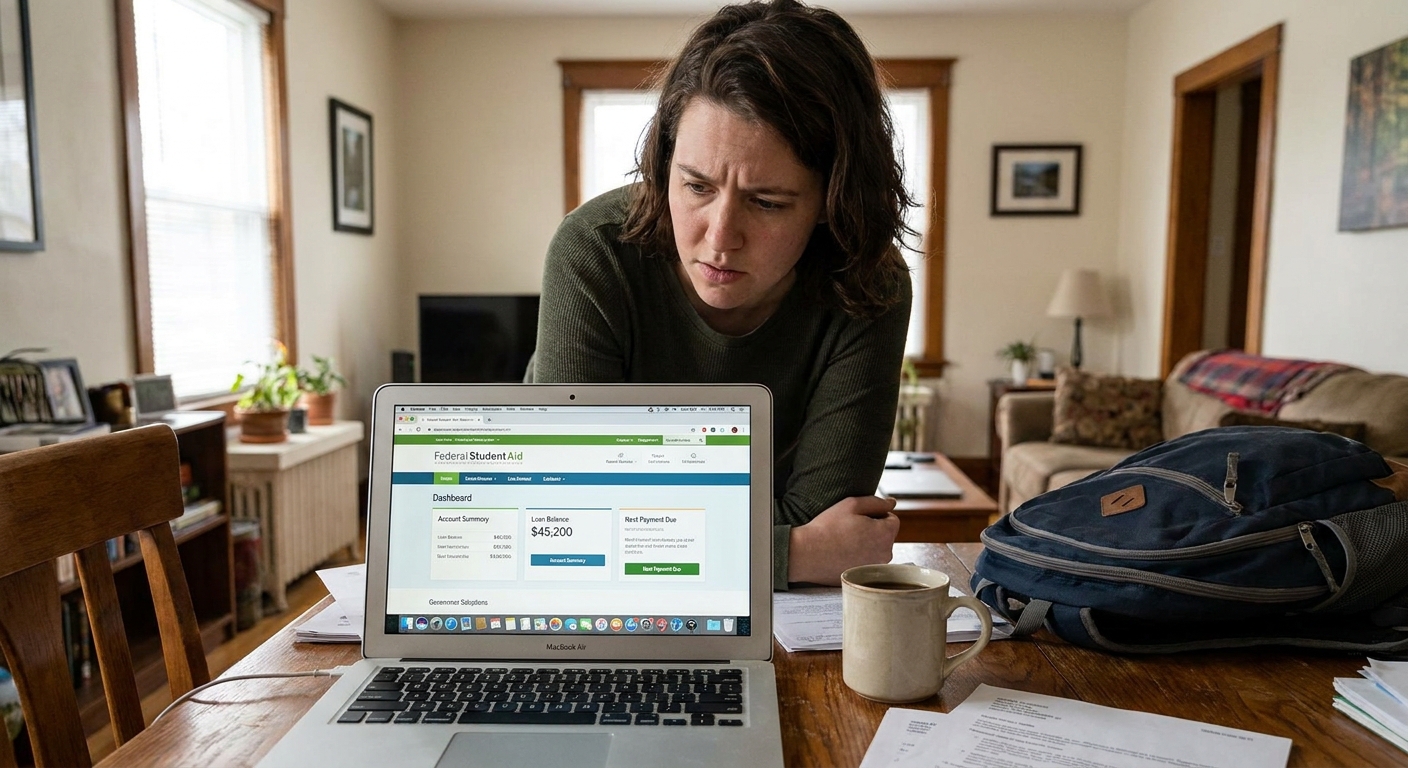
Timing note: consolidation is not instant. It can take several weeks for the payoff of old loans and creation of the new loan to fully process.
What you can gain (and what you might give up)
Potential gains
- Access to Direct Loan-only programs: Consolidating FFEL or Perkins into a Direct Consolidation Loan can make those balances eligible for programs like PSLF and certain income-driven plans, depending on current rules.
- Simpler repayment: One bill, one servicer, fewer moving pieces.
- Ability to include loans in an IDR strategy: Helpful if you are building a longer-term forgiveness plan.
Potential losses and tradeoffs
- Grace period loss: If you consolidate loans right after you leave school (or during your grace period), you can give up the rest of your 6-month grace period and enter repayment sooner.
- Perkins cancellation benefits: If you consolidate a Perkins Loan, you may lose Perkins-specific cancellation options.
- Interest capitalization: Any unpaid interest on the loans you consolidate can capitalize , meaning it may get added to your principal balance.
- Borrower benefits tied to old loans: Some older loans can have repayment incentives that do not carry forward.
- Deferment and forbearance status changes: Consolidation pays off the old loans and creates a new one, so any existing status on the old loans may not carry over the way you expect. Confirm how your situation will be handled before you submit.
- Progress toward forgiveness clocks: Consolidation can change how past time in repayment is credited, depending on the program and the rules in effect.
If you are unsure, pause and check your loan types in your StudentAid.gov dashboard. Knowing whether you have Direct, FFEL, or Perkins is the difference between a smart move and an expensive “oops.”
Consolidation and PSLF
If you work for a qualifying government or nonprofit employer, consolidation can either help or hurt your PSLF progress depending on your loan types, your existing payment counts, and when you consolidate.
PSLF basics in one paragraph
PSLF forgives the remaining balance on eligible Direct Loans after you make 120 qualifying monthly payments while working full-time for a qualifying employer and while on a qualifying repayment plan.
When consolidation can help PSLF
- You have FFEL loans: FFEL loans are generally not eligible for PSLF unless they are consolidated into the Direct Loan program.
- You have Perkins loans: Perkins loans are generally not PSLF-eligible unless consolidated into a Direct Consolidation Loan.
How consolidation affects PSLF counts (current rule)
As of July 1, 2024, consolidating loans that have different PSLF (and IDR) qualifying payment counts generally results in the new Direct Consolidation Loan receiving a weighted average of the qualifying payments of the loans you included. In other words, it is not automatically a reset to zero, but it also is not always “keep the highest count.”
Weighted average means your higher-count loans and lower-count loans blend based on how much you owe on each one. If you consolidate a large balance with a low count together with a small balance with a high count, your new consolidation loan count will usually land closer to the large balance’s count.
About older resets and temporary adjustments
Historically, consolidating could reset PSLF payment counts to zero. In recent years, temporary Department of Education account adjustment policies credited certain past time in repayment toward IDR and PSLF for many borrowers. Some of those provisions were time-limited and tied to specific windows.
What to do right now: before you consolidate, confirm how your existing qualifying payment count will be treated under current Department of Education guidance, especially if you are consolidating loans with different counts.
A quick PSLF scenario guide
- All your loans are Direct and you have PSLF counts: consolidation is often unnecessary. It can still make sense in niche cases, but you should assume there is risk because counts may be blended.
- You have FFEL or Perkins loans and want PSLF: consolidation is often the doorway to PSLF eligibility for those balances.
- You have Parent PLUS loans: PSLF can be possible, but repayment plan access is tricky. Some borrowers look into a “double consolidation” approach to broaden plan options, but rules are evolving and this strategy may be restricted. If this is you, verify current policy before acting.
PSLF checklist before you consolidate
- Confirm each loan type (Direct vs FFEL vs Perkins) in StudentAid.gov.
- Download or screenshot your current PSLF payment counts, if displayed.
- Consider whether your loans have different counts, and whether a weighted average would help or hurt you.
- Verify your employer eligibility and submit the PSLF form regularly so your history is documented.
- Choose a repayment plan that is PSLF-qualifying, typically an income-driven plan.
- If you are unsure, consider getting guidance from a student loan professional who understands PSLF rules.
Common mistakes
- Consolidating and then choosing the wrong repayment plan. A consolidation loan is only as helpful as the plan you pair it with.
- Assuming consolidation lowers your rate. It usually does not. It averages your existing rates and rounds up.
- Consolidating during grace without realizing it ends grace. If you consolidate right out of school, you may enter repayment immediately and lose remaining grace time.
- Including a Perkins Loan without checking cancellation options. That is one of the easiest benefits to accidentally give away.
- Stopping payments during processing. Keep paying until you receive official confirmation that the old loans are paid off.
- Not keeping records. Save copies of confirmations, counts, and forms, especially if PSLF is your end goal.
Quick decision guide
Consolidation is often a good fit if
- You need to turn FFEL or Perkins loans into Direct Loans to pursue PSLF or certain IDR options.
- You want a single monthly payment and you understand the term and interest tradeoffs.
- You are comfortable with how PSLF and IDR credit will be calculated for your situation (often a weighted average after July 1, 2024).
You may want to skip consolidation if
- All your loans are already Direct Loans and you are not trying to unlock a specific program benefit.
- You are close to forgiveness or payoff and consolidation could complicate your timeline.
- You would be giving up a grace period or Perkins cancellation benefit you still need.
If you are on the fence, start with the simplest step: list your loans, balances, and rates, then write down your goal in one sentence. Lower payment? PSLF? Faster payoff? The right move depends on the finish line.
Frequently asked questions
Does a Direct Consolidation Loan hurt your credit?
Consolidation itself is not the same as applying for new private credit, and it generally does not involve a hard credit inquiry. But it can change what appears on your credit report as old loans are paid off and a new loan shows up. The biggest credit risk comes from missed payments during the transition, so keep paying until the process is complete.
Can I consolidate just some of my loans?
Yes. You can choose which eligible federal loans to include. This can be helpful if you are protecting a benefit on a specific loan or you do not want to extend the term on a loan that is almost paid off.
Will my interest rate go down?
Usually no. The new rate is a weighted average of the loans you include, rounded up to the nearest one-eighth of 1%.
Will consolidation make my PSLF forgiveness faster?
It can help you become eligible if you have FFEL or Perkins loans. If you already have PSLF counts, the current rule is typically a weighted-average count on the new consolidation loan (as of July 1, 2024), so it can help or hurt depending on the mix of balances and counts.
Bottom line
A Federal Direct Consolidation Loan is a tool. In the right situation, it can unlock PSLF eligibility, simplify repayment, and help you build a clean, stable plan. In the wrong situation, it can cost you benefits, end your grace period early, or change your forgiveness timeline in ways you did not intend.
If you take nothing else from this article, take this: consolidate with a specific goal and confirm how it affects that goal, especially if PSLF is involved and your loans have different qualifying payment counts.