
Long-term care insurance is one of those “adulting” purchases that can make you feel responsible and slightly queasy at the same time. When my wife and I started pricing policies for family members, my spreadsheet brain immediately jumped to the next question: Is any of this deductible?
The good news is yes, qualified long-term care (LTC) insurance premiums can count as a medical expense for tax purposes. The not-so-fun part is that the tax benefit comes with age-based limits, and it works differently depending on whether you itemize or you are self-employed.
One quick distinction that clears up a lot of confusion: being allowed to count LTC premiums as a medical expense is not the same thing as getting a premium that is actually deductible on your return.
First, confirm it is tax-qualified
Before you do any math, confirm your policy is a qualified long-term care insurance contract under federal tax rules. Only qualified contracts get the special tax treatment (including counting premiums as medical expenses).
What usually qualifies
- Tax-qualified LTC insurance (often labeled “qualified” in the policy paperwork).
- Policies that meet federal consumer protection standards, including generally offering benefit triggers like needing help with at least two activities of daily living (ADLs) or having severe cognitive impairment.
What might not qualify
- Nonqualified LTC policies (some older policies, or certain policies that do not meet the federal requirements).
- Life insurance with an LTC rider can be tricky. Some charges may be treated as LTC premiums, but many are not handled the same way. If your policy is a hybrid, you may need the insurer’s annual statement breaking out what portion, if any, is treated as qualified LTC premium.
If you are unsure, look for language in your policy or annual statement indicating it is a “qualified long-term care insurance contract” under Internal Revenue Code Section 7702B, or ask the insurer directly.
Note: State tax rules can differ from federal rules, so your state return may not follow the same playbook.
The IRS age-based limits
Even if your policy is qualified, you cannot always use the entire premium amount for tax purposes. The IRS sets annual age-based dollar limits on how much qualified LTC premium counts as a medical expense.
These limits are based on your age at the end of the tax year, and they generally increase as you get older.
How the limit works
- If you paid more than your age-based limit, only the limit counts as a medical expense.
- If you paid less than your age-based limit, then your actual premium counts.
Important: The IRS adjusts the age-band amounts periodically. Confirm the current year’s limits before you file. The numbers are commonly listed in IRS medical expense guidance (often referenced in IRS Publication 502) and in annual IRS inflation adjustment guidance.

If you itemize: the medical floor
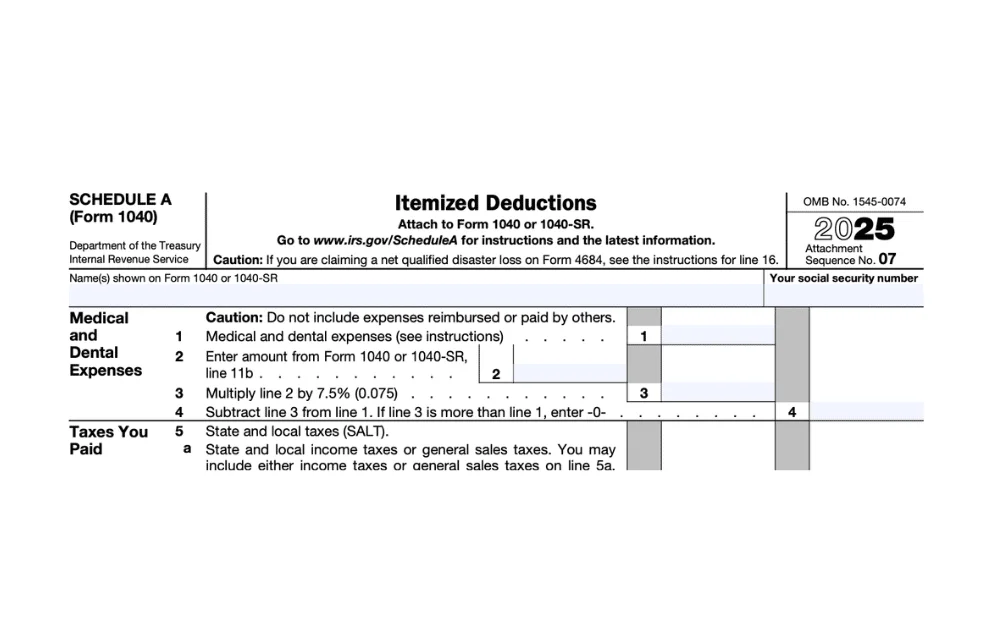
For most W-2 employees and retirees, the LTC premium deduction shows up as part of your itemized medical expenses on Schedule A.
Here is the catch that trips people up: you only get to deduct medical expenses that are above a percentage of your adjusted gross income (AGI). This is often called the “medical expense floor.”
Under current federal law, the threshold is generally 7.5% of AGI, though it is always smart to confirm it for the specific tax year you are filing.
How it interacts with the age limit
Think of this as a filter with three steps:
- Apply the age-based limit to your qualified LTC premiums. This gives you the amount that is allowed to be treated as a medical expense.
- Add it to your other eligible medical expenses (dental, vision, copays, prescriptions, etc.).
- Only the portion above the AGI floor is deductible on Schedule A.
So even if you are allowed to count a few thousand dollars of LTC premium as a medical expense, you may still get zero tax benefit if your total medical expenses do not clear the AGI floor or if you do not itemize.
Quick example
Let’s say:
- Your AGI is $100,000
- The medical expense floor is 7.5% of AGI for your tax year
- Your total eligible medical expenses for the year are $6,000 after applying the LTC age-based limit
7.5% of $100,000 is $7,500. Since $6,000 does not exceed $7,500, none of those medical expenses would be deductible on Schedule A.
If you are self-employed
If you are self-employed and show a profit, you may be able to deduct qualified LTC insurance premiums as part of the self-employed health insurance deduction. This is a big deal because it is generally an above-the-line deduction, meaning you do not have to itemize to benefit.
Key differences vs itemizing
- No Schedule A requirement: You can potentially benefit even if you take the standard deduction.
- The age-based limits still apply: You generally cannot deduct more than the IRS age-band amount for qualified LTC premiums.
- Business profit matters: The deduction generally cannot exceed your earned income from the business under the self-employed health insurance rules.
Common gotchas
- You cannot double-dip: You generally cannot take the same premium as both a self-employed health insurance deduction and a Schedule A medical expense.
- Employer plan eligibility matters by month: For the self-employed health insurance deduction, a common restriction is that you (or your spouse) cannot be eligible to participate in an employer-subsidized health plan for that month. This is a subtle point, but it can change the outcome.
Self-employed rules get nuanced fast, especially with S-corps and partner payments. If you are not sure how your business is taxed, it is worth a quick check with a tax pro.

What counts and what does not
This is where people often overestimate what is deductible. The IRS is talking about qualified long-term care insurance premiums, not every charge you see on a statement.
Generally counts
- Premiums paid for a tax-qualified long-term care insurance contract
- Premiums you pay for a spouse or a tax dependent, if otherwise allowed under medical expense rules
Common items that often do not count
- Amounts not treated as premium: Only amounts treated as premiums on the insurer’s statement generally count. Some fees may be part of premium and some may not, so rely on the insurer’s tax reporting or annual statement.
- Life insurance costs inside a hybrid life policy, if they are not specifically treated as qualified LTC premium
- Employer-paid premiums that you did not include in income (you cannot usually deduct what you did not pay)
- Same expense claimed twice: If you pay premiums with tax-free dollars (for example, a tax-free HSA distribution for an eligible LTC premium up to the annual limit), you generally cannot also claim those same premiums as an itemized deduction. No double tax benefit.
If your insurer provides an annual statement, that is usually the cleanest way to see what portion is considered premium and whether the contract is qualified.
Estimate your deduction
If you want a quick back-of-the-napkin estimate before tax time, here is a simple workflow.
Step 1: Confirm the contract is qualified
Check the policy or annual statement for qualified LTC language, or call the insurer.
Step 2: Find the current year’s age-band limit
Use your age at the end of the tax year. Verify the current year’s IRS age-based amounts because they change over time.
Step 3: Compare premium paid vs your age limit
- Allowed LTC medical expense amount equals the smaller of (premium paid) or (age-based limit)
Step 4A (Itemizers): apply the medical floor
- Add allowed LTC amount to your other eligible medical expenses
- Subtract the AGI floor amount
- If the result is positive, that portion is your potential Schedule A medical deduction
Step 4B (Self-employed): apply self-employed rules
- Apply the age-based limit
- Confirm you have enough net profit
- Confirm that you (or your spouse) were not eligible to participate in an employer-subsidized plan for months you are trying to claim the self-employed health insurance deduction

FAQ
Do I have to itemize to deduct long-term care insurance premiums?
If you are deducting them as a medical expense on Schedule A, yes. But if you qualify for the self-employed health insurance deduction, you may be able to deduct eligible qualified LTC premiums without itemizing, while still respecting the age-based limits.
Are long-term care insurance premiums eligible medical expenses for Schedule A?
Yes, if the policy is tax-qualified, and only up to the IRS age-based limit for the year. After that, your total medical expenses still have to clear the AGI floor to produce an actual deduction.
Can I deduct premiums I pay for my parents?
Possibly. The cleanest path is when your parent qualifies as your tax dependent under IRS rules. However, there are situations where you can include medical expenses you pay for a parent even if you cannot claim them as a dependent, depending on the dependency tests and the medical expense rules. This is one of those areas where it is worth double-checking before you assume the answer is no.
Do LTC premiums work with HSAs?
Potentially. Qualified long-term care insurance premiums can be a qualified medical expense for HSA purposes, but only up to the IRS annual LTC premium limits. And you generally cannot use a tax-free HSA distribution for the premium and also claim that same premium as an itemized deduction.
Where do I find the age-based limits?
The IRS publishes age-band amounts for qualified long-term care premiums. You will often see them referenced in IRS medical expense guidance (commonly Publication 502) and in the IRS’s annual inflation adjustment guidance. Because the amounts can change, confirm the current year’s limits close to when you file.
My practical tip
When readers ask me “How much of my long-term care premium is deductible?” I usually tell them to write down two numbers first:
- Your premium paid for the year
- Your IRS age-based limit for that same year
The deduction math almost always starts with the smaller of those two numbers. After that, it is all about which deduction path you are on (Schedule A vs self-employed) and whether the medical expense floor wipes out the benefit.
If you are close to the line, or you have a hybrid policy, self-employment income, employer plan eligibility through a spouse, or you are paying premiums for a parent, it is worth running the numbers through reputable tax software or confirming the approach with a qualified tax professional. A 10-minute check can save you from taking a deduction you cannot support or missing one you are entitled to claim.