
Closing day is one of those calendar squares that looks simple until you are living it. You have a final walkthrough, a mountain of documents, a mysterious “cash to close” number, and a lot of people saying things like “we are waiting on recording.”
This guide walks you through the full timeline from conditional clear to close to disbursement in plain English, including how funds move, what gets signed in what order, the difference between wet signatures and e-close, and when you actually get the keys.

Quick timeline: clear to close to keys
Every transaction has its own quirks, but most closings follow the same basic rhythm. Here is the “zoomed out” version so you always know where you are.
- Conditional clear to close: Underwriting says you are basically approved, but needs a few final items.
- Clear to close (CTC): Lender is ready to prepare closing documents.
- Closing Disclosure (CD) is issued: Your final numbers are disclosed and signing can be scheduled.
- Final walkthrough: Usually within 24 hours of closing, sometimes the morning of.
- Signing appointment: In-person or remote, depending on what your lender and title company allow.
- Funding: The lender wires the loan money to escrow.
- Recording: The deed and mortgage are recorded with the county.
- Disbursement and keys: Escrow pays out everyone who needs to be paid and you get access based on your contract and local practice.
From conditional clear to close
Conditional clear to close (you are close, but not done)
Conditional approval is underwriting’s way of saying: “We like this loan, we just need the final pieces.” Common last-mile conditions include:
- Updated paystubs or bank statements
- Proof of homeowner’s insurance
- Explanations for a deposit or credit inquiry
- Verification of employment right before closing
- Final title work or HOA documents
My best advice: Treat conditions like a deadline, not a suggestion. Every day you wait is a day your closing can slide.
Clear to close (CTC) and the Closing Disclosure
Once you are CTC, your lender coordinates with the title or escrow company to build your final settlement numbers. That becomes your Closing Disclosure (CD).
For most covered mortgage loans under federal TRID rules, you must receive your CD at least three business days before you close. Some transactions are exempt or follow different rules, so if your timeline feels different, ask your lender to explain what applies to your specific loan.
If you get the CD early, great. Still read it line by line because this is where last-minute surprises like missing credits or incorrect prorations show up.
CD vs settlement statement (quick clarity)
Buyers often hear both terms and assume they are the same thing. They are related, but not identical:
- Closing Disclosure (CD): The lender’s final disclosure of your loan terms and closing costs.
- Settlement statement (often ALTA): The title or escrow company’s final “who pays what” statement that shows the full money flow between buyer, seller, and third parties.
In many closings, the numbers match closely, but the formats and purpose are different.
Final walkthrough
The final walkthrough is not a second inspection. It is your chance to confirm the home is in the same condition you agreed to buy, and that any repairs the seller promised are actually done.

Bring this mini checklist
- Repairs: Verify repair receipts if you have them, and test the actual repair (do not just look).
- Appliances: Run dishwasher, oven, stove burners, microwave, garbage disposal, and confirm fridge is working if it stays.
- Plumbing: Turn on faucets, check under sinks for leaks, flush toilets, check tubs for draining.
- HVAC: Turn heat and AC on briefly to confirm they respond.
- Electrical: Test a few outlets and switches in each room.
- Windows and doors: Open and close, check locks, confirm garage door works.
- Water damage and surprises: Check ceilings, basement corners, around windows, and under HVAC equipment.
- Items that should stay: Confirm fixtures and anything included in the contract are still there.
- Trash and belongings: Confirm the home is broom-clean and seller has vacated as required.
If you find a problem
Do not panic, but do not ignore it either. Your real estate agent should document it immediately and loop in the title or escrow company and the other side’s agent. Common solutions include:
- Seller fixes it before closing
- Seller credits you at closing (shown on the CD and or settlement statement)
- Escrow holdback (money held until repair is completed, if your lender allows it, and note that many loan programs limit or do not allow holdbacks)
- Delay closing if the issue is serious
Cash to close
Cash to close is the total amount you must bring to the table. It combines your remaining down payment, closing costs, and prepaids, minus your earnest money and any credits.
Where cash to close comes from
Think of your closing as one big math problem:
- Plus: remaining down payment, lender fees, title and escrow fees, recording fees, prepaid interest, initial escrow deposits (taxes and insurance), prorations you owe
- Minus: earnest money deposit, lender credits, seller credits, prorations owed to you
Why your cash to close might change
- Property tax or HOA proration adjustments
- Final homeowner’s insurance premium differs from estimate
- Rate lock or points changed
- Last-minute negotiated credit after walkthrough
- Recording fees or local transfer taxes updated
Rule of thumb: Do not schedule your wire or cashier’s check based on an early estimate. Wait for the title or escrow company’s final instructions and confirm the final amount verbally using a phone number you already trust.
How funds move
Earnest money (EMD)
Your earnest money is usually deposited shortly after your offer is accepted and held by the escrow or title company. At closing, it typically shows up as a credit to you on the settlement statement.
Your cash to close: wire vs cashier’s check
Most closings use one of these methods:
- Wire transfer: Common for larger amounts, required by some title companies.
- Cashier’s check: Sometimes allowed if under a certain threshold, and must be payable exactly as instructed.
The lender wire (the big one)
Your lender does not hand you money at the table. They wire the loan proceeds to the escrow account. Depending on your state, lender, and closing workflow, that wire might happen:
- The morning of signing
- After signing is complete and documents are reviewed and approved for funding
- Once the file is cleared to meet the recording cutoff (so recording can happen on time)
If you are ever unsure who is holding what money, ask one simple question: “Is the file funded yet, and has it recorded yet?” Those are the two milestones that decide most of the waiting.
Wire safeguards
Wire fraud is the nightmare scenario because once money is sent to the wrong place, it can be extremely hard to recover. The good news is you can drastically reduce risk with a few non-negotiables.
Follow these wire safety rules
- Never trust emailed wire instructions. Treat them as suspicious by default.
- Call to verify. Use a phone number from the title or escrow company’s official website or paperwork you already have, not the email signature.
- Verify before you send. Confirm the bank name, routing number, account number, and beneficiary.
- Send a small test wire if you can. Some banks allow this. Ask early.
- Know your bank’s wire deadline. Many banks have an early afternoon cutoff.
- Keep proof. Save the wire receipt and confirmation number.
If you receive “updated wire instructions,” slow down. That is a common fraud script. Verify using a known phone number and ask the title company to confirm in more than one way.
Wet signatures vs e-close
Wet signing (traditional closing)
A wet signing is the classic table closing: you sign paper documents with a notary. This is still very common, especially when local recording rules or lender policies require original signatures.
Hybrid e-close (some electronic, some paper)
Many buyers now do a hybrid close where you e-sign some disclosures online and still do a short in-person notary appointment for the documents that must be notarized.
Full e-close or remote online notarization (RON)
In some states and with some lenders, you can sign and notarize remotely via secure video. If this is offered, ask what you need in advance:
- Accepted forms of ID
- Whether you need a webcam and stable internet
- How you will access documents
- What time zone the appointment uses
- A quiet, well-lit space and a device that can allow camera and microphone permissions
Important: Even with e-close, money movement and recording still follow the same rules. Signing online does not automatically mean you get keys instantly.
Signing appointment
Closings can feel like a lot because there are a lot of documents. The order can vary, but here is how it usually goes.
Who is usually there
- You (and any co-borrowers): Anyone on the loan and or title as required.
- Notary: In-person or remote, depending on the closing type.
- Attorney (in some states): Some closings are attorney-led.
Sellers often sign separately and earlier, depending on local practice.
1) Identity checks and basics
- Notary verifies ID
- You confirm how names should appear on title
- You review key settlement figures
2) The big two
- Promissory note: Your promise to repay the loan
- Mortgage or deed of trust: The document that ties the loan to the property as collateral
3) Closing statement and disclosures
You will also sign documents covering items like:
- Final settlement statement and prorations
- Tax forms and reporting affidavits
- Occupancy and identity-related affidavits
- Escrow account disclosures
- Title and insurance acknowledgments
4) Final review and copies
Before you leave or click “finish,” ask for:
- A copy of the signed settlement statement
- A copy of the promissory note
- Contact info for post-closing questions
Recording
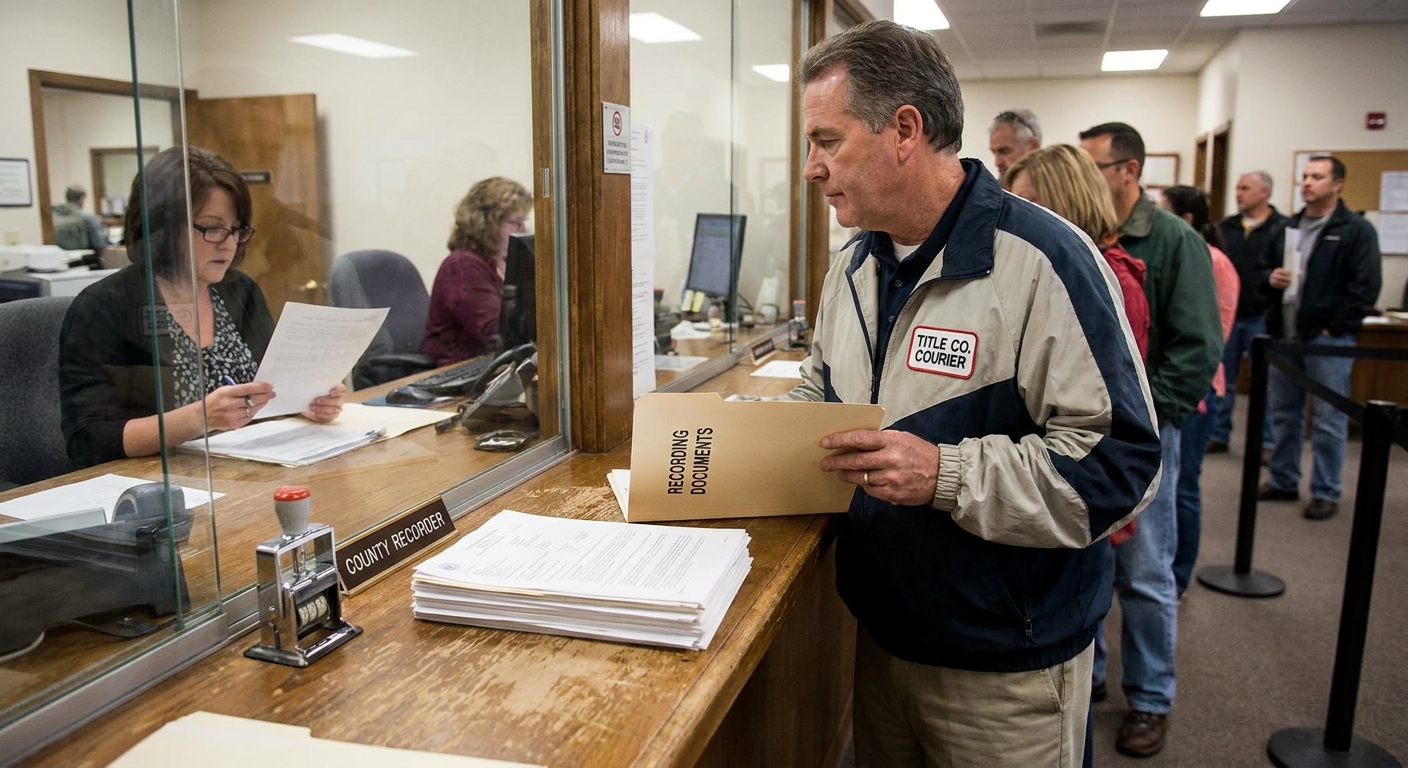
Recording is when the county recorder’s office logs the new deed and the lender’s security instrument into the public record. In many areas, recording is when the sale becomes official, but the true “official” moment can be driven by state law and your contract. When in doubt, ask your agent or escrow officer what triggers ownership and possession where you live.
Why recording can take hours
- The county has limited recording windows
- There is a backlog of documents
- Corrections are needed, like a missing initial or notary detail
- Funds and final lender approval must be confirmed before documents can be released to record
Funding vs recording
- Funded means the lender’s money has arrived in escrow.
- Recorded means the county has accepted and recorded the deed and related documents.
You may hear “wet funding” or “dry funding.” In plain terms:
- Wet funding: Funds are disbursed very close to signing, often the same day, with fewer post-signing steps before funding.
- Dry funding: You sign first, then the lender funds after a post-signing review and final approval. Recording is typically coordinated after funding is authorized so the file can meet local recording requirements and cutoffs.
When do you get the keys?
This is the question everyone cares about, and the answer is: it depends on your contract and local custom.
Common key release scenarios
- After recording: Very common. Once recorded, the transfer is official in many places.
- After funding and confirmation: Sometimes keys release once escrow confirms money is in and the file is cleared for release.
- At a scheduled possession time: For example, “possession at 5 p.m. on closing day” or “possession 2 days after closing” if the seller has a rent-back agreement.
If you are trying to schedule movers, avoid stacking everything on a same-day key release unless you have a backup plan. Recording delays happen even when everything is going right.
Your closing week checklist
48 to 72 hours before closing
- Review the Closing Disclosure and ask questions
- Confirm your homeowner’s insurance is bound and paid as required
- Transfer any needed funds into one account to simplify the wire
- Avoid big financial moves: no new credit, no large purchases, no job changes
24 hours before closing
- Do the final walkthrough
- Confirm final cash to close and wire instructions by phone
- Ask your bank about wire cutoff times
Day of closing
- Bring valid ID, and a second ID if your title company requests it
- If you are married, ask ahead of time whether your spouse must attend to sign any documents (even if they are not on the loan). This is a common last-minute surprise in some states.
- Sign, then stay reachable in case the lender needs a quick clarification
- Wait for the two confirmations: funded and recorded
- Pick up keys only when your agent or escrow officer gives the green light
One more timing note: Your scheduled “closing date” is often the signing date, but the deal is not fully complete until funding and recording (or whatever your local practice requires) are done.
Common last-minute issues
Cash to close is higher than expected
Ask the escrow officer to walk you through the numbers line by line. Look specifically for missing credits, incorrect earnest money, or proration mistakes. Many “mystery” increases are fixable once spotted.
The lender asks for one more document
Reply fast and keep it simple. Upload what they ask for, and avoid adding extra explanations unless requested. If you are not sure what they mean, call and ask for a plain-language description.
Recording is delayed
Delays do not always mean something is wrong. Ask for the status and the realistic next update time. Then plan your day like you will not have keys until late afternoon.
Purchases vs refinances
This article is written for purchases. A quick point that trips people up: most primary-residence refinances have a federal three-business-day right of rescission (a waiting period after signing before funding). Purchases generally do not have this. If you are refinancing, ask your lender what your rescission timeline looks like.
My closing-day mindset tip
When I was getting my own finances together, I learned that anxiety loves vagueness. Closing day is the same way. The minute you understand the milestones, your stress drops.
Keep it simple: walkthrough done, cash to close verified, signed, funded, recorded, keys. If you can track those six, you are in control even when the timeline is not.
Note: This guide is educational, not legal or financial advice. Your lender, attorney, agent, and title or escrow officer can tell you what is required in your state and for your loan.
FAQ
How long does closing day take?
The signing appointment can take 30 to 90 minutes. The full day can take longer depending on funding and county recording timing.
Can I wire cash to close the same day?
Sometimes, but it is risky because of bank wire cutoffs and verification steps. If your title company recommends wiring a day early, follow that advice and confirm their policy on holding funds safely in escrow.
What should I compare between my Loan Estimate and Closing Disclosure?
Compare interest rate, monthly payment estimates, lender credits, and the major fee categories. Small changes can be normal, but large swings should be explained in plain English before you sign.
Do I have to bring a cashier’s check?
Not always. Many closings use wires. Your title company will tell you what forms of payment they accept and the exact payee details if you use a cashier’s check.