
If you’re staring down credit card APRs in the 20% to 30% range, it’s completely normal to look around for a “big lever” that makes the math less brutal. Two common levers are a cash-out refinance and a personal loan. Both can pay off high-interest debt. But they do it in very different ways, with very different risks.
Quick note: these are not the only tools. Depending on your situation, a 0% balance transfer card or a home equity loan/HELOC can also be part of the conversation.
The key tradeoff is simple: a cash-out refinance turns unsecured debt into mortgage debt secured by your home. A personal loan stays unsecured but often comes with a higher rate than a mortgage and a shorter payoff timeline.

Let’s break down the real costs, the hidden risks, and the situations where each option can fail, so you can choose the tool that actually helps you get ahead.
Quick definitions
Cash-out refinance
You replace your current mortgage with a new, larger mortgage. The difference between what you owe and the new loan amount is paid to you in cash. You can use that cash to pay off credit cards or other high-interest debt.
- Secured by your home
- Usually long term (often 15 to 30 years)
- Comes with closing costs
One more reality check: cash-out refis typically have equity and loan-to-value (LTV) limits, plus credit and income requirements. Not everyone qualifies for the amount they want.
Personal loan for debt consolidation
You borrow a lump sum from a lender (bank, credit union, or online lender), use it to pay off your high-interest balances, then repay the personal loan in fixed monthly payments.
- Unsecured (no house collateral)
- Usually 2 to 7 years (some lenders go out to 10 to 12 years)
- Often has an origination fee, but not mortgage-style closing costs
The real comparison
1) Interest rate: usually lower with a mortgage, but not the whole story
Mortgages often have lower rates than unsecured personal loans because the lender has collateral. That lower rate can absolutely reduce your monthly interest burden.
But here’s the trap: lower rate does not always mean lower total cost. If you spread a smaller amount of debt across 20 to 30 years, you can pay a surprising amount of interest over time even at a lower rate.
Mini-example (simplified): Imagine $25,000 of debt.
- Personal loan: 5 years at 12% is about $556/month, and you pay roughly $8,300 in total interest.
- Mortgage: 30 years at 7% is about $166/month, but you pay roughly $34,800 in total interest if you take the full 30 years.
The mortgage payment looks “easier.” The lifetime cost can be brutal if you do not pay that portion down aggressively.
2) Fees: closing costs vs origination fees
Cash-out refinance costs often include items like lender fees, appraisal, title, escrow, recording, and other closing costs. In many cases, these land around 2% to 6% of the loan amount, but it varies by location, loan type, and lender. Discount points can also move the number materially.
Personal loan costs often include an origination fee (commonly around 1% to 8%, sometimes 0%), and you generally do not have the same third-party closing cost stack as a mortgage.
Tip: with either option, look at APR (which includes certain fees) and also ask for a dollar estimate of total interest paid over the full term.
One nuance: APR is useful, but it is not perfect if you expect to sell, refinance, or pay off early. In that case, also compare the cost over the time you realistically expect to keep the loan (for example, 3 to 7 years).
3) Term length: the “decades problem”
This is the big one that gets missed in most debt payoff conversations.
If you owe $25,000 in credit card debt and refinance it into a 30-year mortgage, you might cut your interest rate in half or more. But you also risk paying for that $25,000 like it is a home improvement project, over decades.
A personal loan is typically structured to be gone in a few years. That shorter runway can be painful monthly, but it is often healthier financially because you escape the debt faster.
If you use a cash-out refinance for consumer debt, the “win” is not the lower rate. The win is only real if you pair it with a plan that keeps the payoff timeline short.
4) Collateral and foreclosure risk
Credit card debt and most personal loans are unsecured. If you fall behind, it can wreck your credit and lead to collections, and in some cases legal action. But it is not directly tied to your house.
A cash-out refinance puts your home on the line for past spending. If income drops and you cannot keep up with the new mortgage payment, foreclosure risk becomes part of the equation. That is a fundamentally different level of risk.
5) Credit score impacts: different signals, different timing
Both options can help your credit score over time if they reduce credit card utilization and you make on-time payments. But the path looks different.
- Cash-out refinance: You are opening a new mortgage and paying off an old one. Your credit report changes, and you may see a short-term dip from the new inquiry and new loan. It can also affect average age of accounts and credit mix. If the refi pays down cards, utilization can improve and scores may recover over time.
- Personal loan: Adds an installment account. If you use it to pay off revolving balances, utilization can drop fast, which can help scores. But missed payments hurt just the same.
One practical note: if you consolidate credit card debt and then run the cards back up, your score and your finances can both crash. Consolidation is only a tool, not a cure. (Also, utilization only stays low if balances report low, and keeping cards open can matter.)
When a cash-out refinance makes sense
A cash-out refinance can be reasonable when the numbers and your behavior line up.
It tends to work best when:
- You can get a meaningfully better mortgage rate, or a meaningful strategic benefit, without restarting a large balance at a much longer term than necessary.
- You have strong, stable income and a solid emergency fund, so mortgage payments are not a monthly tightrope.
- You are not using the cash-out as permission to keep spending. The credit card problem is already being fixed.
- You plan to prepay the portion of the mortgage that came from consumer debt, so it is not hanging around for 20 to 30 years.
Also watch the market reality: if your current mortgage rate is far below today’s rates, a cash-out refi can be a non-starter even if your card APR is high, because you may be trading a cheap mortgage for a much more expensive one.
Tax note (because people assume this): mortgage interest is not automatically deductible, and interest on cash-out funds used for non-home-improvement purposes may not be deductible under current rules. If deductibility matters to your decision, confirm with a qualified tax pro.

Green-flag scenario
You have high-interest debt from a specific one-time event (medical bills, temporary income disruption), your spending is now under control, and you can commit to paying extra monthly so the cash-out portion disappears within a few years.
When a personal loan makes sense
A personal loan is often the cleaner consolidation tool because it keeps your home out of it and forces a faster payoff.
It tends to work best when:
- You want a fixed payoff date in 2 to 5 years and can afford the payment.
- Your credit is decent enough to qualify for a rate that beats your credit cards by a wide margin.
- You need simplicity: one payment, fixed rate, fixed term.
- You do not want to pay mortgage closing costs or restart your mortgage clock.
Green-flag scenario
You have $10,000 to $30,000 in credit card debt, your budget is stable, and you can handle a higher monthly payment in exchange for being done quickly.
When each option fails
Cash-out refinance fails when:
- You do not change the behavior. If you pay off cards and then rack them back up, you can end up with credit card debt and a bigger mortgage.
- The term quietly explodes your total cost. A low rate feels like progress, but decades of interest and slower principal payoff can keep you in debt longer than necessary.
- Home values fall and you need to move or refinance again. A higher loan balance can limit flexibility.
- Income becomes unstable. Both mortgages and personal loans have strict required minimum payments. The difference is that with a “pay it off fast” plan, you can usually reduce or pause extra principal payments more easily than you can reduce a required mortgage payment once it is locked in.
Personal loan fails when:
- The payment is too high for your real-life budget, leading to missed payments or new credit card usage to cover basics.
- The rate is not actually competitive due to credit score, debt-to-income ratio, or lender pricing. If your APR is close to your cards, it is not doing much.
- Fees eat the savings. A high origination fee can reduce the value, especially if you plan to pay the loan off quickly.
- You treat it like a reset button instead of a payoff strategy.
A simple checklist
If you like clear decision rules, here are a few that I’ve found keep people out of trouble.
Consider a personal loan first if:
- You can afford the payment on a 3 to 5 year term.
- You want to keep your home out of the equation.
- Your main goal is to be debt-free fast, not just lower monthly payments.
Consider a cash-out refinance only if:
- You are already refinancing for a strong reason (rate improvement, term change) and the cash-out is a smaller add-on, not the whole point.
- You will commit to paying extra monthly so the consumer-debt portion is gone in a much shorter window.
- You have a stable income and a real emergency fund, not wishful thinking.
Hard stop situations
- You are consolidating debt but do not have a written budget that balances.
- You cannot stop using credit cards for essentials like groceries, utilities, or gas.
- Your new plan depends on “everything going perfectly” for the next 12 months.
How to compare offers
When you get quotes, ask lenders for the numbers that answer the key questions: What will this cost me in dollars, and what am I risking to do it?
For a cash-out refinance, request:
- Rate and APR
- Cash-out amount (net after costs)
- Total closing costs in dollars (and whether points are included)
- New loan term and payment
- Break-even timeline if you are refinancing primarily for rate
- Total interest paid over the full term, and also over the first 5 years
- Any prepayment penalty (rare, but confirm)
For a personal loan, request:
- Rate and APR
- Origination fee in dollars
- Term length and payment
- Total interest paid over the full term
- Any prepayment penalty (many do not have one, but you should confirm)
Also consider a middle-ground option: a home equity loan or HELOC. It still puts your home at risk, but it can let you tap equity without replacing your primary mortgage and resetting that rate.
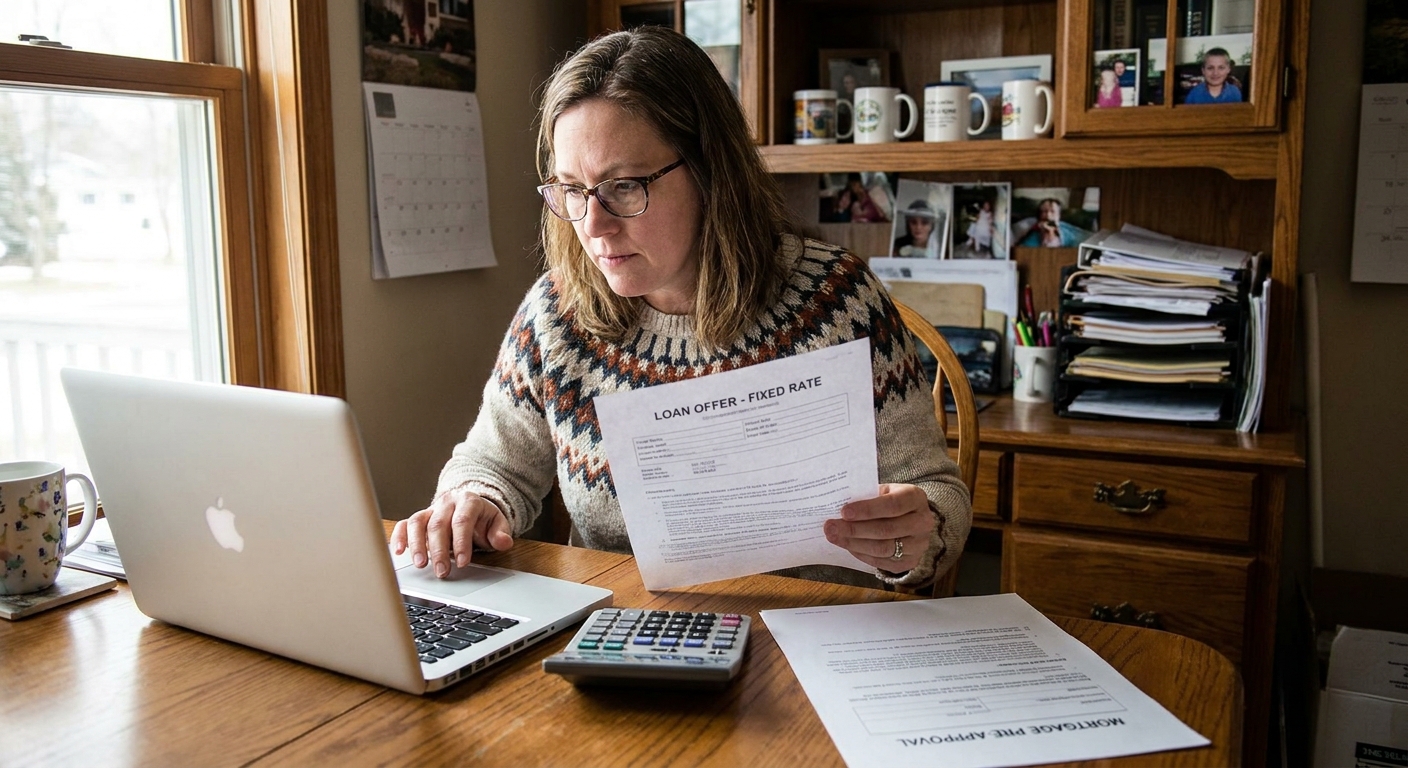
If you choose cash-out: a safety rule
If you do a cash-out refinance to eliminate high-interest debt, treat the cash-out portion like a separate mini-loan and attack it.
- Figure out how much of the new mortgage balance is “old mortgage” versus “debt payoff.”
- Create a payoff target, like 36 to 60 months, for the cash-out portion.
- Set an automatic extra principal payment each month (and know you can always dial the extra down if life happens, but keep the required payment sacred).
This keeps you from accidentally paying for a past credit card season for the next 30 years.
The bottom line
A personal loan usually wins on risk control because your house is not collateral and the term is shorter. A cash-out refinance can win on interest rate, but it raises the stakes and can quietly increase the total cost if you stretch consumer debt across decades.
If you want the decision in one sentence: Use a personal loan when you can afford a faster payoff, and only use cash-out refinancing when you have stable finances and a clear plan to pay the cash-out portion down aggressively.
If you want, tell me your rough numbers (credit card balance, current mortgage rate, years left, and your credit score range), and I can walk you through what to compare so you do not get tricked by “lower payment” math.